
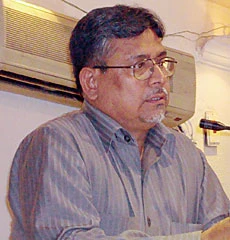
Fifteen thousand eye surgeries and the treatment of 75,000 defective eyes in 15 years. This is no record if one is an ophthalmologist employed in a hospital or running one’s own clinic. It is, however, unusual if it is being done for free and it involves traveling thousands of miles. This is what Dr. Abdul Moiz Shams has been doing with missionary zeal since 1993. Employed in Makkah by the Ministry of Interior since the early 1990s, Dr. Moiz has been using his annual 45-day leave to serve humanity. He says fighting blindness is his passion. “I cannot explain the joy of seeing someone getting back his sight when I perform surgery. My joy becomes even greater if the patient is poor and helpless,” he says.
Dr. Moiz has established an eye care center called Makkah Eye Hospital in his native Sabalpur near Patna, the capital of the Indian state of Bihar. He has a team of volunteers which includes his family members and friends who work with him in the eye camp that he organizes every six months.
Dr. Moiz is associated with the Alkhobar-based Al-Basar International Foundation — a charitable organization for eye care working in 35 countries with hospitals in nine. He says soon after he arrived in Saudi Arabia, he became an Al-Basar volunteer and pledged one month every year to work free for the organization. The first year he went to Senegal and Sierra Leone. The following year he went to Mauritania and Gambia. Along with Africa, Dr. Moiz began work in India as well. In the third year, he added two Asian countries — the Maldives and Nepal — to his itinerary.
“I made full use of my annual vacation. I go to Africa for 15 days, come back to Saudi Arabia, then go to India with my wife and children, drop them in my native village, and then organize camps in India and neighboring countries for 15 days, spend the rest of the vacation with my family and return to Saudi Arabia.”
In the process he realized that his own country deserved his services more than others. His mentor, the famous Dr. J.M. Pahwa, kept imploring him to concentrate on India. “India needs you,” he kept telling Dr. Moiz. Before coming to Saudi Arabia, Dr. Moiz worked in the Gandhi Eye Hospital in Aligarh, 131 km southeast of New Delhi. Dr. Pahwa was the chief medical officer at the hospital and he realized Dr. Moiz’s potential and encouraged him in every way. The hospital is a center for foreign NGOs in India and working there gave Dr. Moiz the opportunity to interact with international voluntary organizations such as Operation Eyesight Universal, Canada, Royal Society for the Prevention of Blindness, London, and Help the Aged.
Dr. Moiz’s area of operation is Bihar, one of the poorest and most neglected Indian states. It is affected by such problems as poverty, illiteracy and lawlessness. Food shortages and malnutrition cause a variety of illnesses and deformities. Blindness and other eye-related diseases are one of them. For a variety of reasons, national and international NGOs do not pay much attention to Bihar but since Dr. Moiz is a native Bihari, he feels very strongly for his state. He says once he started his camps in Bihar, he realized that there was vast amounts of work to be done. “With a little effort, a lot of blindness can be prevented,” he says.
Dr. Moiz says that the work he started 15 years ago has spread so much that he finds it difficult to manage from outside India. So he finally resigned from his job in Makkah and has gone back to India. The Makkah Eye Hospital that he has established in his native village is equipped with the necessary infrastructure, including an air-conditioned operating theater with the latest machines — something not very common in that part of the world.