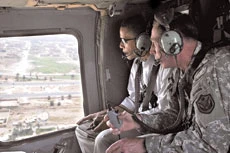
BAGHDAD: Iraq’s top leaders hosted US presidential contender Barack Obama yesterday and offered an apparent sign of shared purpose on hopes of withdrawing American combat troops from the country by 2010.
The comments by Iraq’s government spokesman — as the Illinois senator toured Iraq for the first time in more than two years — stopped short of any open endorsement of Obama’s pledge to pull out combat forces in 16 months.
But it roughly mirrors Obama’s schedule and offered another glimpse of Iraq’s growing confidence to push for a broad framework on cutting US troop levels as violence in Iraq drops and Iraqi security forces expand their roles.
“We are hoping that in 2010 combat troops will withdraw from Iraq,” spokesman Ali Al-Dabbagh said after Obama met with Prime Minister Nuri Al-Maliki, who has struggled for days to clarify Iraq’s position on a possible timetable for a US troop pullout.
Iraq’s Sunni Vice President Tariq Al-Hashemi said after meeting Obama that Iraqi leaders share “a common interest... to schedule the withdrawal of American troops.”
“I’d be happy if we reach an agreement to say, for instance, the 31st of December 2010” would mark the departure of the last US combat unit, he said. He, however, noted that any such goal could be revised depending on threats and the pace of training for Iraqi security forces.
In Washington, White House press secretary Dana Perino said Iraqis are driving harder in negotiations on troop levels, but the United States will resist any “arbitrary” timing. “It will not be a date that you just pluck out of thin air. It will not be something that Americans say ‘we’re going to do, we’re going to leave at this date,’ which is what some have suggested,” she said.
The Bush administration has refused to set specific troop level targets, but last week offered to discuss a “general time horizon” for a US combat troop exit.
Obama made no detailed statements on his meetings, which included Iraqi President Jalal Talabani. “Excellent conversation,” he said as he left talks with Al-Hashemi in his gold-hued reception room and promised to give his full impressions after his stop in Iraq wraps up today and he heads to Jordan and then Israel.
“Very constructive,” Obama added after leaving a meeting with Al-Maliki, who was quoted last week by a German magazine apparently supporting Obama’s 16-month withdrawal proposal. The government claimed his remarks were misunderstood.
It was the third leg of Obama’s tour of the region, which has included stops in Kuwait and Afghanistan.
The counterpoint was clear: Obama opposed the Iraq War from the start and views the battle against the resurgent Taleban and Al-Qaeda in Afghanistan as America’s most critical fight.
But Iraq is not the same place as when Obama last visited in January 2006.
Both Sunni insurgents, including Al-Qaeda in Iraq, and Shiite militias have suffered significant blows. And security forces in Baghdad — once the scene of near-daily car bombs and sectarian killings — have made clear gains since last year’s troop build up of nearly 30,000 soldiers.