
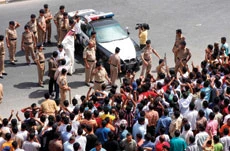
KUWAIT: Hundreds of mainly Bangladeshi workers went on strike for a third day in Kuwait yesterday, seeking better pay and improved working conditions, with some overturning cars and ransacking offices.
The strike by Asian cleaners and workers began on Saturday against a backdrop of soaring inflation and high prices.
Riot policemen wielding batons broke up a demonstration and made several arrests in Jelib Al-Shuyukh, northwest of Kuwait City. A second protest took place in Mahbulah, south of Kuwait City, witnesses said, without specifying if there had been any police intervention.
The Bangladesh Embassy said police used tear gas to disperse the workers. Shahriar Kader Siddiki, who is the embassy’s labor secretary, said tear gas was used at two locations yesterday. Security officials could not be immediately reached for comment.
Commerce and Industry Minister Ahmad Baqer said Kuwait would investigate workers’ grievances and ensure their rights were respected, the state news agency KUNA reported.
“The company wants me to pay money all the time. Money, money, I have to pay money,” one Bangladeshi worker in his 30s told Reuters TV, adding that workers wanted a net salary of 50 dinars ($188) per month without any deductions for visa fees.
On Sunday, three Bangladeshis working for employers were injured when workers attacked them, a security source said.
“And the revolution of the hungry has erupted,” Al-Anba newspaper said on its front page.
Baqer said the government would ensure workers were paid their regular salaries. “And if any injustice happened to them, then they should go to the relevant authorities, the Ministry of Social Affairs and labor courts. I have no doubts that they will get their rights,” he told KUNA after a Cabinet meeting.
A string of strikes has sparked calls by Parliament deputies to improve conditions for expatriates, mainly Asians and Arabs, who make up two thirds of Kuwait’s 3.2 million population.
In May the Kuwaiti Interior Ministry warned that it would deport foreigners who instigate gatherings and strikes and would prosecute the participants. About 200,000 Bangladeshis work in Kuwait, mostly as cleaners and in other low-paid jobs.
Hundreds have gone on strike in recent months complaining of nonpayment of salaries or delays in obtaining their wages as well as inhuman working conditions.
They have also charged that they are receiving half of the $200 monthly salary promised them in Bangladesh before arriving in Kuwait.
Cabinet Minister Faisal Al-Hajji added the government would make sure obligations in labor contracts would be honored.
Struggling to fight inflation, the Kuwaiti government has raised wages of Kuwaitis twice this year, while raising subsidies for basic food items to control prices.

