
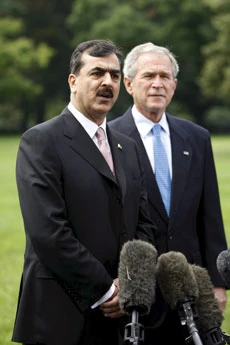
WASHINGTON: US President George W. Bush offered $115 million over two years in food aid to Pakistan, the White House said yesterday, after he met with Pakistani Prime Minister Yousaf Raza Gilani.
“The president offered $115 million over two years in food aid and $42.5 million of that will be available over the next six to nine months,” White House spokeswoman Dana Perino told reporters.
Bush praised Pakistan’s prime minister for being committed to the joint battle against extremists.
But neither of the men addressed the news of the latest clash in Pakistan, a missile strike that hit a religious school just inside the Pakistani border with Afghanistan.
Bush and Gilani strolled before the assembled media on the South Lawn of the White House after a private meeting.
Appearing upbeat, the two leaders sought to publicly ensure their constituencies the US-Pakistan bond is tight despite tensions between the nations.
Bush said their session was constructive, as he expected.
“After all, Pakistan is a strong ally and a vibrant democracy,” the president said. “Of course we talked about the common threat we face, extremists who are very dangerous people,” Bush said.
Gilani sought to reassure Bush of his government’s commitment to securing its border with Afghanistan. Gilani said his government was “committed to fight against those extremists and terrorists who are destroying and making the world unsafe.”
Bush praised Gilani for his government strong commitment to secure the volatile regions. The vote of confidence came as US officials have called for Pakistan to stop militants from staging cross-border attacks on US forces in Afghanistan.
“We talked about the need for us to make sure the Afghan border is secure,” Bush told reporters after the White House talks, adding that Pakistan had made a “very strong commitment to that.”
“We’ll fight for our own cause,” Gilani said. But he stopped short of making any concrete public promises about how Pakistan would deal with militants in its border areas.
Gilani said he wants the people of the United States to know that vast majority of Pakistanis want peace, and want to cooperate with the US.
Pakistan has resisted suggestions that US or other foreign troops should be allowed into the remote region to combat militants.
Pakistan officials say they are working to strike agreements that would require the tribes to give up their weapons, withdraw support for foreign fighters and end attacks across the border.
US and Afghan officials say Taleban fighters are sheltering in Pakistan. Militants based in Pakistani tribal areas, where Osama Bin Laden and his top aide are believed to be hiding, have said they are sending fighters to Afghanistan.
Washington seeks to pressure the Pakistani government to crackdown on militants responsible for attacks on US forces in Afghanistan.
The issue has been a source of tension between the two countries, with the US skeptical of efforts by the Pakistanis to secure peace deals with tribal leaders in remote areas of the country used by militants to launch cross-border raids into Afghanistan.
Washington has also noted the past peace agreements with the tribal leaders have failed to halt the violence and only make it easier for the Taleban to operate.

