
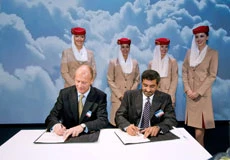
DUBAI: Dubai carrier Emirates underscored the rapid growth of air travel in the oil-rich Gulf region yesterday as it takes delivery of its first Airbus super jumbo, the world’s largest civilian airliner.
Chief Executive Sheikh Ahmed bin Saeed Al-Maktoum, in the German port city of Hamburg to collect the A380, also announced the airline has signed a letter of intent to buy 60 more planes from the European manufacturer.
The government-owned airline is already the largest single client of the A380, with a firm order for 58 planes in deal worth about $18.8 billion based on list prices.
Emirates’ new arrival will be put straight to work, with non-stop flights to New York starting on Aug. 1.
“A380 will represent... one of the essential pillars for Emirates’ growth in the future,” Sheikh Ahmed said on Saturday.
The letter of intent announced in Hamburg yesterday is for 30 A330-300s and 30 A350s. Emirates, the fastest growing carrier in the Middle East, has had a long wait for delivery of the A380 superjumbo after repeated Airbus delays. The first plane had initially been scheduled for October 2007.
But despite the snags, Emirates has maintained its commitment to the aircraft, raising its initial order from 43 to 58, with the first batch of five due for delivery by March 2009, according to the UAE official WAM news agency.
In September 2007, Emirates President Tim Clark said he wanted to double the carrier’s order for the jetliner, which stood then at 55 planes, but he said Dubai airport, the Middle East busiest hub, “can (only) handle so much.”
Emirates, which operates a 113-strong fleet, is awaiting construction of Dubai’s second airport, which is expected to be the world’s largest with six runways and the capacity to handle 120 million passengers a year.
The booming city-state of Dubai and its flag carrier are leading the way in aviation growth in the Gulf region, with aggressive expansion of airports and airline capacity. Other players from region — which is enjoying a windfall from record oil revenues — are treading the same route, while in general world aviation is suffering because of soaring fuel costs. Earlier this month, the Abu Dhabi-owned carrier Etihad Airways stole the limelight at the Farnborough International Airshow in Britain, ordering 100 new aircraft from Airbus and Boeing in deals worth $20.4 billion.
The deal with Airbus included 10 A380s. Etihad, which began flying just five years ago and now has a fleet of 32 planes, said it was considering the purchase of another 105 passenger planes from Airbus and Boeing worth about $22.6 billion.
FlyDubai, a new low-cost airline launched by the government of Dubai, signed a deal at Farnborough for 54 single-aisle Boeing 737 passenger jets worth $4 billion.
Qatar Airways, another fast-growing regional carrier, operates a fleet of 62 aircraft, priding itself as having one of the “youngest and most modern fleets in the skies.”
The government-owned carrier says its fleet will expand to 110 planes by 2013. Its orders include five Airbus A380s and 80 units of the A350, as well as 30 Boeing 787 Dreamliners.
Fleets are expanding in tandem with multi-billion-dollar airport projects across the region as passenger numbers grow.
Dubai airport handled 18.4 million passengers in the first half of 2008, an increase of 13.8 percent from the same period last year, and a third terminal is almost ready, aiming to increase capacity to 60 million passengers annually. Abu Dhabi’s small airport saw a 38 percent increase in passenger numbers in the first half of this year to 4.25 million, compared to just over three million.
The airport is being expanded to host 20 million passengers in 2010.
Qatar’s existing airport handled 10 million passengers in 2007, but a new $9 billion airport is expected to open for traffic in 2010, with a capacity to handle 24 million passengers a year.
Meanwhile, the region’s first no-frills carrier Air Arabia, based in Sharjah, celebrated this month carrying 10 million passengers since its launch late 2003.
It transported 1.6 million passengers in the first half of 2008, up 33 percent from last year.