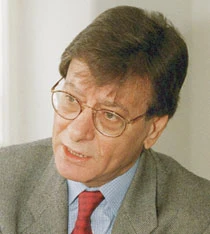
WASHINGTON: Mahmud Darwish, widely considered one of the greatest Palestinian poets, died yesterday in a US hospital following openheart surgery.
“Mr. Darwish has died at 1:35 p.m.,” said Ann Brimberry, a spokeswoman for the Memorial Hermann Hospital in Houston, Texas, where he was being treated, told reporters.
Darwish had been in critical condition in the US hospital and, according to a friend in Jerusalem, had been placed on life support two days ago following complications arising from the surgery.
In a career spanning nearly five decades, Darwish published more than two dozen books of poetry and prose rooted in his experience of Palestinian exile and the bitter Middle East conflict.
A sequence of poetry and prose written about his experience living in Beirut during the Israeli invasion and bombardment of Lebanon in 1982 was translated into English in 1995 under the title “Memory for Forgetfulness”. “The street. Seven o’clock. The horizon is a huge egg made of steel. To whom shall I offer my innocent silence?” he writes in the book.
“I walk slowly, so that a jet fighter may not miss me. The void opens its jaws, but it doesn’t swallow me. I move aimlessly, as if getting to know these streets for the first time and walking on them for the last time.”
Darwish had been justifiably critical of Israel over the years and was detained several times in the 1960s before going into self-imposed exile in 1970. Over the next 25 years Darwish wandered from place to place, spending time in several Arab capitals and briefly residing in Moscow and Paris.
In 1988, Darwish wrote the official Palestinian declaration of independence and served on the executive committee of the Palestine Liberation Organization (PLO) until 1993, when he resigned in protest at the Oslo accords. He had been living in the West Bank town of Ramallah since 1995.
In 2000, a proposal by then Israeli Education Minister Yossi Sarid to teach Darwish’s works in public schools sparked a political firestorm and led the right-wing opposition to register a no-confidence vote in the government.
In July 2007, Darwish decried Hamas’ takeover of the Gaza Strip a month earlier in his first poetry recital in Israel since quitting the Jewish state in 1970.
“We woke up from a coma to see a mono-colored flag (of Hamas) do away with the four-color flag (of Palestine),” Darwish said before nearly 2,000 people who attended the reading in the northern port city of Haifa.