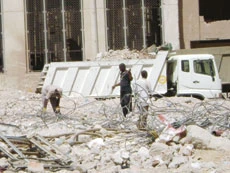
MAKKAH: The demolition of buildings around the Grand Mosque is a source of wealth for not only real estate developers but also for African overstayers who are involved in the difficult but rewarding job of collecting scrap.
Thousands of young and old Africans, who live in Makkah without formal residential papers, stream daily to those areas that are under demolition in the Shamiya, Shubaika and Harat Al-Bab districts of central Makkah. They take whatever they find, including iron, steel, windows, doors and electric wires from the buildings.
The expansion is taking place in the eastern part of the Grand Mosque where the government has purchased around 1,000 properties. “The expansion of the Grand Mosque has been a source of wealth for us,” a Nigerian national told Arab News, adding that he often salvages valuable items at demolition sites.
“We pay the officials in charge of the demolition to allow us to collect scrap, including windows, doors, pipes, electric wires and other materials. However, in the present demolition we couldn’t pay anyone and get permission from the workers. So we just enter the buildings and take whatever we can put our hands on,” he said, speaking on condition of anonymity.
Another Nigerian overstayer said scavengers have formed groups according to their nationalities and different groups do different tasks. “Young boys and girls will be supplied with garbage bags to collect clothes, shoes, chandeliers and other small items. The old will collect building materials. Everything will then be taken to the selling point at Hosh Bakr in Al-Mansour Street,” he said.
“We start our work early in the morning after Fajr prayers and we’ve made good money out of this business,” he added.
A Chadian, known by his first name Haroun, said he and his colleagues would pay money to workers at the site to collect discarded material for them. “They put it aside for us to come and take away. This is a very profitable business since it does not need any investment,” he said.
Some citizens and visitors were surprised that the Passport Department is turning a blind eye on overstayers. “These people are endangering our lives when they take scrap in their vehicles or on their shoulders,” they said.
The police, however, denied that they were ignoring the problem and said they would not allow traffic violations to take place.
Col. Ahmed bin Nashi Al-Otaibi, director of traffic in the city, said that since the start of the expansion process, a plan has been formulated and executed to ensure the smooth flow of traffic. “We are very sternly dealing with violators,” he added.