SRINAGAR: Indian troops shot dead a prominent Kashmiri separatist leader and four other protesters yesterday as they tried to halt huge Muslim demonstrations in the revolt-hit region, witnesses said. Sheikh Abdul Aziz, a former militant turned moderate political leader, was killed while taking part in a protest march close to the Line of Control, which separates the Indian and Pakistani parts of the Himalayan region.
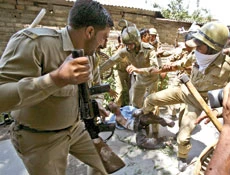
A police official said four other protesters were killed on a day of fierce clashes in the disputed Kashmir Valley. Police said the day’s violence has also left at least 200 people injured.
A doctor at Srinagar’s main hospital, Manzoor Ahmed, confirmed that All Parties Hurriyat Conference (APHC) leader Aziz died of a gunshot wound. “We will spill blood for blood,” Aziz’s supporters chanted as they carried his body out of the hospital, signaling the killing could unleash a new round of violence after several years of relative calm.
Authorities imposed an indefinite curfew across the valley and moved in police and paramilitary troops in full strength. Thousands of people carried the body of the separatist leader to the historic Jamia Masjid from where it would be taken to his native Pampore town in south Kashmir.
Aziz, a senior separatist leader and chairman of the People’s League (PL) joined the moderate APHC headed by Mirwaiz Maulvi Omar Farooq in January this year after his release. He was jailed several times since 1988 when militancy erupted here.
“This is the real face of Indian democracy,” said Farooq, adding that Aziz’s death was a “big loss” to the separatist movement. “For demanding lifting of an economic blockade we get bullets, while Hindu fanatics who are attacking Muslims in Jammu and setting their property on fire are allowed to do whatever they want,” he fumed, appealing for international action.
Aziz, who had been jailed on several occasions for demanding Indian Kashmir be handed to archrival Pakistan, is the third prominent separatist leader to have been killed since the eruption of the Muslim insurgency in 1989.
The shooting came as Indian security forces tried to prevent about 100,000 Muslims from marching toward the de facto border with Pakistan — one of the biggest protests ever seen in Kashmir.
The marchers had reached a point just 40 kilometers from the heavily militarized border despite repeated efforts by Indian police and paramilitary forces to stop them with tear gas, rubber bullets and warning shots.