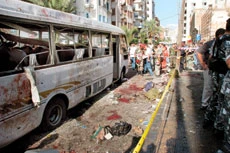
TRIPOLI, Lebanon: At least 15 people, including nine soldiers, were killed in Lebanon yesterday in the deadliest attack on the army since a battle with Fatah Al-Islam militants last year.
An army statement described the attack in this northern city as a terrorist bombing. It said the bomb had been placed in a bag at a bus stop where soldiers usually gather.
Another 45 people were wounded. Four were in a critical condition, medical sources said.
Red Cross workers ferried casualties to hospital. The ground was spattered with blood and covered in shards of glass. “It seems that the bomb was detonated wirelessly by remote,” Lebanon’s police chief Ashraf Reefi said. Security sources had earlier put the death toll at 18.
There were no immediate claims of responsibility for the attack in Lebanon’s second largest city, which has been the scene of fighting between security forces and militants and sectarian violence linked to political tension in Lebanon. “The army and security forces will not yield to attempts to terrorize them with attacks and crimes,” said President Michel Suleiman, who was army chief until elected president in May.
Suleiman led the army during 15 weeks of fighting last year with the Fatah Al-Islam group, which was based in a Palestinian refugee camp near Tripoli. The army lost 170 soldiers while putting down the insurrection.
“It could be a signal from the same militant groups that they are still around,” said Paul Salem, head of the Carnegie Endowment’s Middle East Center in Beirut. “It’s a pretty clear signal to the army.”
The Tripoli attack was the latest jolt to stability in Lebanon, which has suffered a wave of bombings and political killings since the 2005 assassination of former Prime Minister Rafik Hariri.
The list of assassinated figures includes Francois Al-Hajj, a senior army officer blown up in December. The Tripoli attack was the deadliest internal bombing since Hariri’s assassination. “The investigation has begun and there are many interpretations, political interpretations,” Information Minister Tareq Mitri said, responding to media speculation that the attack was designed to undermine a visit to Syria by Suleiman. He arrived in Damascus late last night for the first time since his election as president. Suleiman met Syrian President Bashar Assad in a visit seen a sign of improved ties between the two countries.
Saudi condemnation
Saudi Arabia condemned the bombing and offered condolences to the families of the blast victims. In a statement issued by a government spokesman and carried by the Saudi Press Agency, Riyadh reiterated its support for Lebanon and called on “all sincere people to stand by the state and strengthen the internal situation through dialogue”.