
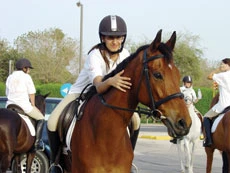
THE Saudi national equestrian team is now in Beijing participating in the Olympic Games. And following their deeds avidly is Latifah Al-Sheikh, the youngest female jockey, who is in spirit in Beijing with her countrymen.
She hopes that Saudi riders excel in Beijing, but along with this hope she nurtures an aspiration to ride in the national colors and go for the gold in the world’s greatest sports spectacle.
“I wish to participate in the Olympics one day and make history for my country by winning a gold medal,” the 15-year-old jockey said.
Women in the Kingdom face regulatory and cultural restrictions regarding their practicing sports and participation in competitions. Saudi teams include only men, whereas women aren’t allowed high school physical education classes much less an opportunity to become Olympians.
But times are changing in Saudi Arabia, and a high school student’s dream may yet become a reality because there is a slow movement in the Gulf region that allows for women to enter sports arenas (that too is banned in the Kingdom). So while Saudi Arabia continues to hold steady to traditional women’s roles, its neighbors are moving forward. Women can drive in nearby Gulf counties. They get physical education classes. They don’t need a special paper from the government that shows their guardians allow them to travel abroad. Women can attend football games in other Gulf countries. They’re elected to parliamentary positions. And now, the most recent indication that other Arabian Peninsula countries are leaving Saudi Arabia in the dust when it comes to greater freedoms for women: Omani athlete Buthaina Al-Yaqoobi, the first woman from the Arabian Peninsula to participate in the Olympic Games. For the young Saudi rider, Al-Yaqoobi is a hopeful sign that someday Saudi Arabia will lighten up on women when it comes to athletics. Al-Sheikh says the difficulties that Saudi women face in sport is mainly due to cultural misconceptions.
“Girls are officially prohibited at schools to practice any kind of sports,” she said. “In contrast, they (the Omani women) are taught that to have a healthy mind you need a healthy body! In order to encourage women in sports we should start first by changing the stereotypical image about it and enhance that by establishing a sport infrastructure and facilities as well as implementing programs to enable girls to feel fully involved in the universal movement to promote women in and through sport.”
The cultural and regulatory difficulties haven’t stopped some Saudi girls from chasing their dreams such as Al-Sheikh, who receives full support from her family.
2 horses and a dream
She enjoys a very special bond with her horses Rocky and Diablo and never gets tired of riding or grooming them at the Dhahran Stables of Saudi Aramco. It is through them she sees her future as a champion jockey.
Her relationship with horses started when her father signed her up for an equestrian lesson. What he had in mind was just an outlet for his little girl to practice a hobby. But the hobby turned into a passion and today she has proved that she is not an easy jockey to beat.
Despite her young age, she has won several ribbons and trophies at a number of amateur jumping competitions before she officially joined the Kingdom Holding Company Equestrian Team in 2007.
Throughout her two-year career, she participated in five regional competitions, Kingdom of Bahrain - 120km endurance (Arabian horses are prizes for their distance running while North American horses are typically short-distance “quarter horse” sprinters) - in 2007, was her first professional appearance and she came in second in that event.
Bahrain remains a happy hunting ground for the Saudi teen jockey.
“I had some of the best winning moments in Bahrain, especially when the King of Bahrain Sheikh Hamad ibn Isa Al-Khalifa called me ‘the little hero’ at the King’s Cup race in 2007,” she said. Al-Sheikh came in third in that championship.
The Saudi teenager takes the fame and the attention, including the constant flashes of camera that comes along with her participation, in her stride. “I have never thought of fame other than doing what I like,” Al-Sheikh said.
But she hopes to be a trailblazer in equestrian by setting an example of excellence.
“I hope that my experience encourages girls to seek and pursue their hobbies and even make a career out of it,” she added.
Multicultural experiences contributed in making the teenage jockey the person she is now.
“I learned the basics of horseback riding and jumping fences from three foreign trainers from England, Holland and Syria,” she said.
“My current jumping instructor is from France and for endurance (which pushes the horse to his maximum speed and effort), I’m trained by the national instructor, Najeeb Al-Barjas,” Al-Sheikh said.
Constant training
Al-Sheikh pointed out that endurance running and jumping require different skills.
“Jumping needs constant training,” she said. “I train three times a week before a jumping competition, but in endurance it takes me a week to train in advance of any contest,” she added. Although she is happy to be supported by her family, friends and trainers, she notes that some individuals in society consider girls’ participation in sports against tradition.
“I haven’t met with these people (who air their views) to understand their point of view, but I read their comments online and I respect them,” she said.
The recent appointment of female jockey to the board of the Saudi Arabian Equestrian Federation has given great hope to many women riders who want to enter this field.
Arwa Mutabagani is the first woman to be appointed to an official federation and her inclusion was in recognition of her contribution to the sport. “Appointing more women to official sport bodies is very important to take female sports in the Kingdom on the right track and create a healthier and more active society,” she said. In her opinion, Saudi women have proved that they are great jockeys and excel with enthusiasm and persistence. “I believe that Arab women excel in such sport because it derives from our culture,” Al-Sheikh said.
For the moment, Al-Sheikh is content to saddle up and race, hoping to prove that she has the mettle to go for an Olympic medal.