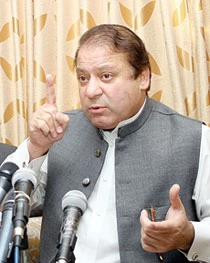
ISLAMABAD: Former Prime Minister Nawaz Sharif finally parted ways with Asif Ali Zardari yesterday, one week after the two of them forced Pervez Musharraf to resign as Pakistan’s president.
“We have decided to leave the coalition and withdraw our four ministers from the federal government,” Sharif announced at a crowded press conference here.
“We have taken this decision after we failed to find any ray of hope and none of the commitments made to us was fulfilled (by Zardari, head of the Pakistan People’s Party),” Sharif said.
Sharif had set a Monday deadline for some 60 judges sacked by Musharraf to be reinstated, but Zardari’s party — the largest in the coalition — had refused to give a time frame on when that would happen.
Political observers say the PPP is unlikely to restore the judges out of fear that they could overturn an amnesty on corruption charges that allowed Zardari to return to Pakistan last year.
Sharif accused Zardari of repeatedly breaking promises over the judges issue. “The PPP also violated the latest agreement reached earlier this month that the judges will be restored 24 hours after the resignation of Musharraf,” he said.
“The PPP even nominated Zardari for president and announced the election schedule without consulting our party,” Sharif said, and added that his Pakistan Muslim League (N) party would field retired Justice Saeeduz Zaman Siddiqui as candidate for president. “He is a good Pakistani who is a nonpartisan person.”
Siddiqui hailed the PML (N) as the “most popular party” in the country and said it had followed “politics of principles.”
The PPP announced Saturday that Zardari would be its candidate for president. Sharif said that violated an earlier agreement with the PPP for a nonpartisan candidate if the presidency retained certain powers, including to dismiss Parliament.
Sharif said he would not try to destabilize the government. “We’ll play the role of a constructive opposition and sit on the opposition benches,” he said.
The departure of his party is not expected to force a general election as PPP should be able to gather enough support to govern.
The coalition, formed after Musharraf’s allies lost a February general election, had looked increasingly precarious since Musharraf’s resignation.
The PPP and Sharif’s party were bitter rivals during the 1980s and 1990s, when Benazir Bhutto and Sharif were both chosen twice as prime minister, but they found common ground more recently in their opposition to Musharraf.
His departure undermined the logic of their alliance.
— With input from agencies