
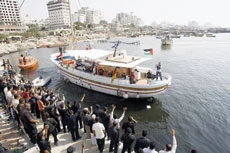
AS Huwaida Arraf, along with 43 other activists, boarded one of the two wooden boats in Cyprus intent on breaking the Israeli siege of Gaza by sailing to the Palestinian territory, her family in Michigan was “worried sick.”
“My family has experienced Israeli military violence but, by sailing to Gaza, we have shown that we will not tolerate Israel’s cruel siege on the people of Gaza, that we will not be silenced,” said Arraf, co-founder of the International Solidarity Committee (ISC).
“My family was scared because they know what the Israeli military is capable of doing to unarmed civilians.”
They sought updates of the prevailing situation in the occupied territories, trying not to think of the tragic fate of Rachel Corrie, who was run over by a bulldozer operated by Israeli Defense Forces (IDF) during a protest against the destruction of Palestinian homes. An Israeli military investigation ruled the death accidental. Corrie was also a member of the ISC.
While Arraf sailed with the tide, Osama Qashoo stood at the side of his boat, tasting the salt-water spray, and with it, the bitter aftertaste of disappointment. While the rest of the activists sailed to Gaza, he had to return to Cyprus. He had hoped to film the expedition.
“My immediate family in the West Bank has been threatened, I had to get off the boat,” he said. It was not so long ago that the young filmmaker fled persecution in the Palestinian territories. He remembers watching young Israeli soldiers humiliating elderly Palestinians at checkpoints, he remembers the beatings, and the way his friend took three bullets to the head for doing nothing more than hold up a ‘Free Palestine’ banner.
Qashoo cringes at the idea that he may have been responsible for his family’s humiliation at the hands of the Israelis as he listened to radio updates of the progress of the protest boat. Over the last few months, the activists have said that they have been threatened and harassed. They had to fight the diplomatic pressure that Israel was applying on Cyprus and Greece to prevent the boats from sailing. (The boats were meant to sail on Aug. 5 or 6 but they left on Friday, Aug. 22, and reached early Saturday.) Their radios were jammed and they were followed. The Israeli Navy had said they would intercept the boat and could arrest and detain the activists. Still, they persevered, determined to establish a maritime link between Gaza and the international community.
As the boats approached, Prime Minister Ehud Olmert and Defense Minister Ehud Barak were busy discussing its fate behind closed doors. When they emerged from the meeting, the navy was told not to block the boats.
“It was clear from the beginning that this whole operation was a provocation aimed at making Israel look bad,” a senior defense official said prior to the boats’ arrival. “We decided to let them through in order not to play into their hands.”
Two hours outside Gaza the radios stopped crackling and their satellite link went dead. The crew’s constant signals for help were met with an eerie silence. The boats lurched as the sea turned stormy, fighting the gray choppy water as they pushed forward. A boat full of journalists had left to meet them and document their defiance of the yearlong Israeli-blockade of the Gaza Strip, but they couldn’t make radio contact.
BACK on land, Angela Godfrey-Goldstein, spokesperson for the Free Gaza movement was confused. “We are victims of electronic piracy, I’m sorry, can we talk later, this is a crisis here, the only phone working is a journalist’s unpublished satellite phone,” she said from the Israeli port of Ashdod early Saturday morning, Aug. 23.
They had been at sea for over 30 hours, exhausted, and some very seasick. But the mood on board became buoyant when they realized they had made it into Gaza waters. The activists raised Palestinian flags, bringing down the Greek flags they set sail under. Yvonne Ridley, a British activist and journalist on board, likened breaking the siege to “pulling down the Berlin Wall.”
“Now I know how people felt when they tore down those first few bricks. Today is a huge victory of people over power,” she said.
Arraf remembers the first sight of the Gaza skyline energizing the activists. “It was a beautiful sight that only got more beautiful as we approached. We forgot how seasick we were. We were expecting to be sitting in an Israeli prison, instead we were welcomed by thousands of Palestinians, (some) jumping into the water to welcome us,” said Arraf.
Although Israel withdrew its settlers from Gaza, independent aid workers said Israeli ‘disengagement’ from Gaza is diplomatic whitewash. The military has a stranglehold on airspace, coastal waters and airwaves. The 365 sq km tract of land has six border crossings, all of which have been sealed tight, allowing only a trickle of humanitarian aid into the territory.
Aki Nawaz is sailing back to Cyprus with the activists who have defied Israel’s choke hold on Gaza, broken the siege and left behind several human rights workers to serve as volunteers and witnesses.
The British Asian rapper says, “I am horrified to find that all the books I read about Nazi cruelty inflicted on the Jews is being practiced here by Israelis on the Palestinians. They are being squeezed for food, diesel, for water, for electricity (the power plant relies on diesel), there is no economy, and they cannot fish in their own waters. It is sickening to the stomach.”
As the activists walked through the streets of Gaza, past throngs of cheering Palestinians, in and out of medical facilities and schools, they began to grasp the impact of the siege. One after another, the activists describe how a man-made humanitarian disaster is starving Palestinians into submission on a barren strip of land serving as “the world’s largest open air prison.”
ACCORDING to rapper Nawaz: “I wanted to get on the front lines of the struggle because it is one thing to talk, but it is another to bear witness and see the dignity of the people of Gaza in the face of this injustice. I am here because I am completely and utterly repulsed at the political arena that has allowed this conflict to last so long.”
Although the Oslo Accords guarantee Palestinian fishing boats 20 nautical miles to fish in without fear, the Israeli military currently insists on allowing fishermen about six miles. Palestinians say they start shooting if they cross three or four miles.
“The fishermen have to fish close to land in polluted water because Gaza has a sewage crisis. Israel will not allow them a 2-km pipeline that will ease the problem,” Arraf explained.
So the activists set out to sea again, this time to provide a protective cover for Palestinian fishermen who had not cast their nets out at sea to haul up nets full of fish since two fighters attempted a failed bid on the Israeli Navy in 2003.
“The Israeli Navy followed us to about nine nautical miles but they didn’t stop us — the Palestinians fished in waters they hadn’t been in for years, it was a happy moment for us but sad to see how grateful the fishermen were to have access to their own waters,” said Arraf.
There is already a waiting list for the next boatload of activists ready to reiterate that this is a not one-off gesture by the human rights workers. They say the siege is not about security for Israel, it is about punishing the Palestinians. The road closures and fishing limits are a death sentence the activists have decided to appeal. Now the decision to act must be made in the international court of public opinion.