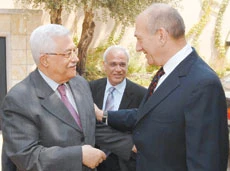
JERUSALEM: Palestinian President Mahmoud Abbas rejected Israel’s idea of an interim peace agreement at a summit yesterday, a Palestinian negotiator said, insisting on an all-or-nothing approach that virtually ruled out an accord by a January target date.
The latest meeting between Abbas and Israeli Prime Minister Ehud Olmert was their shortest, lasting less than an hour. Neither side pointed to progress.
Olmert entered the meeting in a weakened position after his decision to submit his resignation this month when his party picks a new leader. Just two days before Abbas arrived for talks at Olmert’s residence, Israeli police passed through the same entrance to interrogate Olmert for the seventh time in a series of corruption cases.
Abbas, too, is not in a strong political position, having lost control of Gaza to Hamas last year.
Because of Israel’s complicated political system. Olmert could still find himself in office next year, even if he resigns this month as promised. His aides said he hoped the Palestinians would sign a document outlining any agreements reached with Israel before he leaves office.
But Palestinian negotiator Saeb Erekat said Abbas flatly rejected that at the summit yesterday.
“We want an agreement to end the (Israeli) occupation and establish an independent Palestinian state with Jerusalem as its capital,” Erekat told The Associated Press.
“President Abbas told Olmert that we will not be part of an interim or shelf agreement,” he said. “Either we agree on all issues, or no agreement at all.”
The Israelis had a more upbeat take on the summit. Olmert spokesman Mark Regev said “significant progress had been made in the talks,” but “there are still considerable gaps between the two sides.” He would not elaborate.
At a US-sponsored peace conference last November, Olmert and Abbas pledged efforts toward a peace treaty by the time President George W. Bush leaves office in January 2009.
But frequent summit meetings and negotiating sessions since then have made little apparent progress on the core issues that have stymied peace efforts for decades — including borders, Jerusalem and Palestinian refugees.
Erekat refused to confirm the private views of officials on both sides that some headway has been made on setting borders between Israel and a Palestinian state.
Officials in Olmert’s office said Israel has proposed giving the Palestinians all of Gaza, 93 percent of the West Bank along with Israeli land equivalent to 5.5 percent of the West Bank, as well as a land corridor through Israel to link the two separate territories. The Palestinians have said that offer is unacceptable. Instead, the Palestinians complain bitterly about continued Israeli construction in West Bank settlements.