
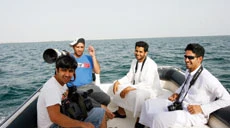
OVER a period of several months, small teams of young professional photographers will tour the various regions of the Kingdom to take photos. The photos will be published in a book titled “The Kingdom Through Young Saudi Lenses.” The coffee-table book, featuring Arabic and English, will feature about 500 photographs.
A team of art directors and graphic designers from Al-Mohtaraf Assaudi — the design house that is initiating this project — will assist the photography effort and will undertake the responsibility of photo selection and photo editing for both the book and the touring exhibition.
“We strongly felt that it was high time the Kingdom is represented comprehensively through the interpretation of its own children, while at the same time reflecting their own sense of refined taste, vision and profound sensitivity of a new generation of Saudi youth,” said Kameel Hawwa, the director of Al-Mohtaraf Assaudi.
According to Hawwa, the idea of the book started with the realization that graphic design in the Kingdom, as well as advertising and publishing, needs photography taken by Saudi photographers.
“The book plays the dual role of introducing somehow a different Saudi Arabia to the world on one hand, while simultaneously introducing a new young generation as reflected in the photographic works of those young men and women,” Hawwa added.
“A photo represents a photographer as well as the subject he is shooting. Its actually a bit strange how a photo of a subject that has no local bearing or cultural peculiarity, can still look different when taken by two separate photographers of different cultural backgrounds. This book is about having our photography, for a change, show our country.”
When Al-Mohtaraf assumed responsibility of Al-Qafila, the bimonthly cultural magazine of Saudi Aramco, it included a photography supplement in the center of the magazine as a resting spot for the reader to enjoy. So Al-Mohtaraf set out looking for Saudi photographers across the country. Hawwa said at that time, the supplement played a key role in introducing and encouraging young Saudi photographers.
Following long and open discussions with the photographers, the consensus was the paramount need to capture fresh looking stills to ultimately represent the true image of the Kingdom.
In the beginning of the project, the process was somehow slow. Now several hundred professional and amateur photographers, male and female, from all around the Kingdom have already submitted their work.
The young photographers’ portfolios shared many recurring themes. “We attributed this to a number of reasons, mainly the fact that the young Saudi’ lenses were limited in terms of what they could capture on account of certain restrictions and social sensitivities,” Hawwa said.
“Yet there was also, we thought, the influence of foreign photographers who seemed to always look for ‘the strange,’ concentrating mainly on topics like folklore and traditional aspects of the Kingdom, without taking in regard everyday life and its modern-day Saudi interests, dreams, facial expressions and spontaneous lifestyle,” he added.
Saudi Aramco is financing the book all the way to the printers. Once complete it will be a memento of the company’s 75th anniversary. Once the book is out, there will be a comprehensive exhibition under the title
“The Kingdom Through Young Saudi Lenses” that will be made ready to tour within the Kingdom and abroad. Its various destinations will be determined through agreements with local and international authorities many of which have already expressed interest in such an exhibition.
Tareq Al-Abdulla, the project organizer and the one responsible for managing the photographers and trips around the Kingdom said that five to 15 photographers from around the Kingdom are participating in the book.
“The photographers trips started two months ago. Usually, trips take four to five days,” said Al-Abdulla.
Al-Abdulla said the idea of the book is presenting Saudi Arabia from the youth perspective. “Our aim is to illustrate our culture through the youth,” he said. “We are taking spontaneous pictures everywhere. However, it is hard somehow to take photos of families for example but we are trying our best.”
Al-Abdulla along with his team of photographers faced some incidents with police prohibiting them of taking pictures for certain areas such as Jeddah Cornish.
“There is a royal decree from the king allowing taking pictures wherever possible except for places that has no photos banner,” said Al-Abdulla.
“However, there is no awareness among the police.” Qasim Al-Mutair, a 23 year-old student majoring in Architect, one of the photographers participating in the project considers this project as a new challenge to show everyone the place Saudi youth has reached today. “I believe its time to change people’s stereotypes about Saudi Arabia,” said Al-Mutair. Al-Mutair is taking spontaneous photos for his university community and campus.
“I am also participating in the trips. We just came back from Al-Ahsa in the Eastern Province one week ago,” he said.
As for women participating in the project, Al-Abdulla said that they don’t mind their contributions. However, there are some restrictions when it comes to women going for trips.
“There are some girls roaming around major cities like Jeddah. They are taking photos for historical sites for example,” he said.
Snap at your own risk
WHILE the government officially made general public photography legal a few years ago, photo-shy Saudis are typically very averse to being captured on film, especially women. And because of the spread of WiFi technology, this aversion has gotten stronger as the gadgets have gotten smaller and more prevalent. A picture taken today can be on the Internet in seconds, which has raised concern from many Saudis worried about where their faces will end up. Even under the more liberal interpretation of Saudi public photography, photographers must get the permission of everyone included in the photographs - even for general shots where people just happen to be in the frame. For example, even if you’re taking a picture of the seaside Corniche with families in the background, anyone who noticed you pointing a camera at them has a legal right to demand you do not take the photograph or delete the image. By comparison, many Western countries allow some leeway for public photography on the basis that a photographer has a right to shoot general public pictures without the unrealistic expectation of getting permission from each and every person who might end up in the frame.
Essentially, any person being photographed in any way or context (even crowd shots) has absolute control over his or her rights, in public or in private, to be photographed. The law prohibits the photography of government buildings, too.
A concern expressed by many photographers is that many street-level law enforcement officials (especially outside of the cities) are unaware of looser restrictions on snapping pictures in public, which means photographer may be harassed for taking pictures even if the photos they’re taking are legal. This climate offers a unique challenge for photographers.