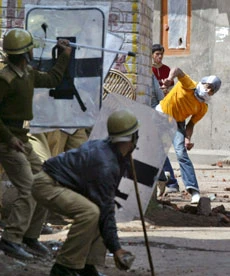
SRINAGAR: A complete shutdown crippled normal life across Kashmir yesterday where six persons were wounded in fresh clashes as the state authorities removed the valley police chief in a major police shake-up. Police said six persons were injured, two of them received bullet injuries when police opened fire, shelled tear gas and used batons to disperse stone pelting mobs at Safakadal, in old city.
Police fired tear gas in Indian Kashmir to disperse hundreds of angry demonstrators protesting the killing of a man by government forces and to oppose elections due in October, police said yesterday.
The Kashmir government yesterday made a major reshuffle in the state police by shifting 14 senior police officers from their places of posting.
Notable of yesterday’s reshuffle is the shifting of Kashmir Inspector General (IG) of police S.M. Sahai and his replacement by B. Srinivas, who was IG operations north Kashmir range.
Shops, banks and government offices were closed for the day, and public and private vehicles stayed off the roads across much of the region in response to a strike called by Muslim separatist groups protesting Indian rule in the disputed region.
Protesters blamed government forces for fatally shooting Javed Ahmed Bhat, a 23-year-old bystander, on Saturday in Srinagar, the summer capital of India’s Jammu-Kashmir state.
Government forces fired rubber bullets and tear gas to disperse an angry crowd on Saturday as well.
More than two months of angry protests have left at least 43 people dead in Indian-controlled Kashmir, most of them killed when soldiers opened fire on Muslim protesters.
Protesters yesterday clashed with government forces at three places in Srinagar, said Prabhakar Tripathi, a spokesman for the paramilitary Central Reserve Police Force. One paramilitary soldier was injured by rocks thrown by the protesters.
Yesterday’s strike was called by the Jammu-Kashmir Coordination Committee, whose members include Muslim separatist leaders and representatives of businesses, lawyers and government employees.
Syed Ali Shah Geelani, a key pro-Pakistan leader, also warned the Indian government yesterday against holding state legislative elections in the region, which are due in October. “If New Delhi goes ahead with the elections, it will add fuel to the fire in Kashmir,” said Geelani.
Geelani’s comments came as India’s Election Commission began consulting various political groups to set a date for the election. Geelani and two other separatist leaders, Yasin Malik and Mirwaiz Omar Farooq, have been put under house arrest by Indian authorities since Friday to prevent them from leading protest marches.
Farooq yesterday told reporters that India was pursuing a “policy of force, intimidation and terror to subjugate” people in Kashmir. “When you are making peaceful revolution impossible, you’re making violent revolution inevitable.”
Farooq also demanded that the Indian allow cross-border trade between Indian Kashmir and that part of the Himalayan region that is controlled by Pakistan. “India should open the cross-border road for trade and people, or entirely close it. We’re determined to see it as an alternate route, not yet another symbolic move.”
Currently, India only allows passenger bus service twice a month between the two regions, though government officials have said that they are considering allowing trade across the border.
Farooq said a trade delegation from the Indian Kashmir was planning a visit to Pakistan-controlled Kashmir. The latest unrest, the worst to hit Kashmir in more than a decade, was triggered by a government move to hand over land to a Hindu shrine. Muslim separatist leaders launched protests in June saying the government plan was aimed at changing the demography of the Muslim-majority region.
The plan was quickly scrapped, angering the region’s Hindu minority who also launched their own massive protests, forcing authorities to allow Hindu pilgrims temporary use of land near the shrine. The Muslim separatists’ demonstrations have however snowballed into a broader anti- India movement.