BEIRUT: Lebanon’s President Michel Suleiman invited rival leaders yesterday for talks next week that were set to focus on the fate of the military wing of Iranian-backed Hezbollah group.
The talks, set to start at the presidential palace on Sept. 16, were stipulated in a Qatari-brokered deal that ended the country’s political crisis in May.
Hezbollah’s weapons emerged as a main divisive issue after the group used some of its military muscle to defeat its foes in street fighting in Beirut and other areas in early May.
The Western-backed majority coalition says Hezbollah should be disarmed after Israel pulled out of Lebanon while the group and its allies, backed by Syria and Iran, say the weapons were needed to defend Lebanon against “Israeli threats.”
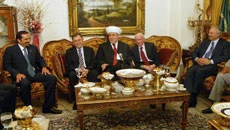
Hezbollah fought a 34-day war against Israel in 2006 which killed 1,200 people in Lebanon and 158 people in Israel. Suleiman announced the talks at a fast breaking banquet he held for Lebanese leaders to mark the holy month of Ramadan.
The United Nations and the international community want Hezbollah to be disarmed and transformed into a political party. The ruling coalition says the government should have full control of all armed forces in Lebanon and it alone should hold the war and peace decisions.
The group, which has Parliament members and a Cabinet minister, says it is willing to discuss a “defense strategy” that would define the role of its guerrillas and the Lebanese Army in confronting Israeli threats.
Hezbollah has thousands of highly trained guerrillas, equipped by tens of thousands of rockets capable of hitting Israel, as well as anti-tank and anti-ship missiles.
It is widely believed that the group had rearmed and even strengthened its military might since the 2006 war despite a UN ban. An 18-month political crisis threatened to erupt into all out civil war in May when Hezbollah briefly seized control of the Muslim half of Beirut routing pro-government gunmen.
The violence led to talks in Doha and an agreement that stipulated the election of Suleiman, formation of a unity government, agreement on a law for next year’s parliamentary election and the holding of talks to discuss divisive issues. Politicians from both camps see little chance that next week’s talks would reach a full agreement but hope holding them would ease sectarian tensions threatening instability.