
WASHINGTON — The US State Department yesterday ordered the Venezuelan ambassador here expelled, amid tit-for-tat expulsions with both Venezuela and Bolivia that also added a twist to US-Russian tensions.
The US Treasury said meanwhile it was freezing any US assets of two senior Venezuelan intelligence officials and a former interior minister after accusing them of aiding Colombian rebels involved in drug trafficking.
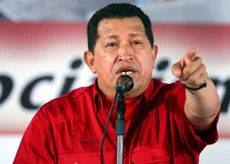
Venezuelan President Hugo Chavez warned meanwhile that his country will act militarily if his embattled ally Evo Morales in Bolivia is toppled, after highlighting the arrival this week of two Russian Tu-160 strategic bombers.
An increased Russian military presence in Latin America has added a twist to Washington’s growing tensions with Moscow over last month’s Russian military incursion into US-backed Georgia, formerly part of the Soviet Union.
State Department spokesman Sean McCormack said he regretted the expulsions by Caracas and La Paz, but claimed they reflected the “weakness and desperation” of both leaders.
McCormack noted that Chavez said he was recalling his ambassador to Washington, Bernardo Alvarez Herrera, and did not know whether he had actually left already, but added “he will be expelled,” rather than simply recalled.
Chavez on Thursday ordered US Ambassador Patrick Duddy to leave the country within 72 hours, in a move he described as an act of solidarity with Venezuela’s ally Bolivia.
Facing violent anti-government protests, Morales on Wednesday ordered US Ambassador Philip Goldberg expelled, accusing him of contributing to divisions in the country which the government warned was headed toward “civil war.”
The charges are “baseless,” said McCormack, who termed the expulsion “is a grave error that has seriously damaged” US-Bolivian relations, including efforts to fight drug trafficking.
The State Department then ordered the expulsion of Bolvia’s Ambassador to Washington Gustavo Guzman.
Violent anti-government protests have killed eight people in Bolivia, where rightist governors have rebelled against the popular president, demanding autonomy and rejecting his plans to overhaul the constitution and break up ranches to give land to poor Indians.
In addition to ordering Ambassador Duddy to leave, Chavez announced Thursday that his government had uncovered a coup plot hatched by active and retired military officers, which he said had tacit US approval. McCormack also rejected those charges.
Chavez has also announced naval exercises with Venezuelan and Russian warships in November, highlighting what he calls a “strategic” alliance with Moscow.
The US Treasury also sanctioned Venezuelan officials Hugo Armando Carvajal Barrios and Henry de Jesus Rangel Silva and former official Ramon Rodriguez Chacin over aid to the Revolutionary Armed Forces of Colombia (FARC).
The three “armed, abetted, and funded the FARC, even as it terrorized and kidnapped innocents,” according to a statement from Adam Szubin, who heads the Treasury’s Office of Foreign Assets Control (OFAC). “Today’s action freezes any assets the designated entities and individuals may have under US jurisdiction and prohibits US persons from conducting financial or commercial transactions involving those assets,” it said.
Honduran snub
Meanwhile, Honduras, a former US ally in Central America now run by a leftist government, told a US envoy not to present his credentials as ambassador yesterday in a diplomatic snub in support of Bolivia. Honduran President Manuel Zelaya, who has moved the country closer to Chavez, was due to receive a new US ambassador yesterday in a ceremony at which the envoy would present a letter with his diplomatic credentials.
But Zelaya temporarily put off the event in support of Bolivia, a government source said.
“The government decided to temporarily suspend the reception of the new ambassador’s letter of credentials in solidarity with Bolivian President Evo Morales,” the source said.

