
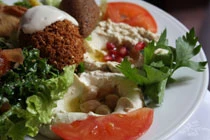
WHAT is it about Lebanese food that attracts many? Why is it a rage from Australia to Sweden? And why is it even the most popular cuisine in the Middle East? Even Saudis freely admit their unconditional love for Lebanese food. Some of the first restaurants in Saudi Arabia were Lebanese. And Lebanese restaurants are still increasing in numbers throughout the Kingdom.
No one would dispute the fact that the Lebanese act as unique ambassadors for their national cuisine. They enjoy eating as much at home as in a restaurant so, wherever, you see Lebanese people you are sure to find Lebanese restaurants. The newly opened “Ammouneh” on Prince Sultan Street (famous in Beirut for its shawarma sandwiches and home cooking) has become the ultimate gastronomic meeting point for Lebanese food aficionados in Riyadh.
“Customers say that they smell Lebanon in the restaurant and they feel as if they are in Lebanon. We specialize in authentic Lebanese home cooking. Seventy percent of our customers are Saudis and they love our dish of the day especially the Kibbe bil Laban,” said the restaurant director, Mohamed Ammouneh.
Shawarma is one of the most popular Arabic fast foods in Lebanon. Although this meat sandwich looks so easy to make, its preparation is long and complex and requires an elaborate equipment. After the meat and fat have been sliced, they are marinated for 24 hours. Layers of meat are then placed between layers of fat onto a huge vertical skewer, which is finally topped by an onion, tomato and lemon. Ammouneh offers the real Lebanese shawarma sandwich served in Arabic bread or in the saj, thin bread cooked on a griddle. Customers eagerly queue up until 2 a.m. to buy a shawarma sandwich renowned for its secret blend of spices and marinade.
Ammouneh also serves another popular Lebanese street snack: Falafel, fried bean croquettes. A mixture of chickpeas, garlic, onions, parsley, coriander and cumin is ground to a paste. This dough is then shaped into small flat balls and deep fried until the crust is brown and crispy. Falafel are mostly served as sandwiches along with tahina, mint, parsley and tomatoes.
Lebanese cuisine is quintessentially traditional; furthermore it is not precise and sophisticated like Chinese or French cooking. Recipes are passed from mother to daughter and each family has its own way of preparing home cooking. Its virtues are loyalty and respect for custom and tradition, reflected in the unwavering attachment to the dishes of the past. Many Lebanese specialties have been cooked for centuries, from the time they first appeared, basically unchanged.
One of the most outstanding features of the Lebanese cookery is the large selection of appetizers known as mezze, which can prove to be a meal in itself. There is an almost endless number of hors d’oeuvres, some restaurants can serve up to 70, and even more mezze. These include lamb tongues, brains, chicken livers, chopped kidneys, spinal marrow, stuffed vine leaves, kibbeh, hummus, puff-pastry cases filled with cheese, spinach or minced meat; some of the most common appetizers are based with pulse such as ful (mashed broad beans dressed with olive oil and lemon juice) and falafel (patties made from white broad bean, spiced and deep-fried in oil).
Vegetables comprise of a vast selection of appetizers. One of the most unique appetizers of the Lebanese cuisine is the famous tabbouleh, a refreshing salad, which originated in the Lebanese mountains and is now popular throughout the world. It is made with chopped parsley, mint, tomatoes, green onions and cracked wheat known as burghul.
Burghul is a treated whole-wheat grain, including the wheat germ, it is therefore rich in protein, mineral salts, and carbohydrate. It is made by cooking the wheat, then drying and cracking it.
Savory pastries are one of the most interesting features of Oriental cuisine. Lebanese food offers a great variety of stuffed pastries in the shape of half-moon, triangles, fingers and an Arab type of pizza with a meat, cheese or zaatar filling, a mixture of thyme, salt and sumac (a sour, browny-red seed ground to a powder) with toasted sesame seeds.
Another great Lebanese specialty is kibbeh. In the past, the preparation of kibbeh was a strenuous ritual: The meat and wheat were pounded in a stone mortar with a heavy metal pestle. This backbreaking and exhausting practice has been made much easier thanks to the electric blender.
Lebanese food reflects the light, colors and smells of the country, it also echoes the unique hospitality, warmth and energy of its people. Lebanese restaurants like Ammouneh offer true Arab hospitality by giving their customer the very best.
For more information: Tel 920 000 822