
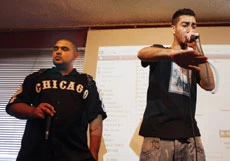
Teenage rappers Yassin Kassem and Mohammed Turk have no qualms about upsetting politicians or clerics when they sing of inter-Palestinian violence and the daily hardship of life in the refugee camps.
They call themselves I-Voice — Invincible Voice — and are among a number of rap groups to have emerged from impoverished Palestinian camps in Lebanon and from the Israeli-occupied Palestinian territories.
Turk, 18, and Kassem, 19, really shook the hornets’ nest with a song called “Inkilab” (Revolution) which addressed inter-Palestinian fighting and divisions and how the various factions are handling the Palestinian cause.
“We got told by many (political parties) to stop and sort of got threatened about singing one song in particular,” said Kassem about Inkilab.
“We just said ‘yes’ and kept on singing it.” Inkilab slams the main Palestinian political factions for losing sight of the cause and also for what the duo says is gang-like behavior.
“The solution for the liberation of Palestine is civil war,” go the lyrics. “The medal of honor goes to conspiracies that made our lives disgusting.” The rappers have also had run-ins with organized religion. One cleric warned people not to listen to them, during a sermon at weekly Friday prayers in the northern refugee camp of Nahr Al-Bared, after the pair staged a concert there.
“I laughed,” said Kassem. “Here I am trying to wake people up, make them aware and drag them away from the superficial and they accuse me of forcing them to do bad things!” The pair recorded their first album in August last year in a makeshift studio in a narrow alleyway in Beirut’s overcrowded Burj Al-Barajneh refugee camp.
“The harder the life you live, the more you love hip hop,” said Kassem.
He raised the money to buy recording equipment for the basement studio by juggling different jobs over two years and with the help of friends. “I had friends in Australia who sold some of my CDs for me and helped me buy some equipment.”
As Kassem and Turk write and record their music in the tiny studio with walls and ceilings covered with grey sponge soundproofing, they contemplate the poverty that surrounds them. “I immediately liked rap music. It’s an expression of all things that are wrong in society,” said Turk, who is also known as TNT.
Palestinians are banned from 25 professions in Lebanon and many face difficulties finding a job. The harsh living conditions inside Burj Al-Barajneh camp are plain to see. Sewage floats down alleyways, many buildings have tin roofs and exposed electric cabling drapes walls and is hung between streets. “Everyone sings about something. They talk about the camps and how they look and the suffering inside them,” Kassem said.
“We talk about problems too, but we also talk about solutions to those problems.”
Kassem has just finished high school and hopes for a scholarship to enrol in college, while Turk dropped out of school at the age of 12 and got a job in a factory to support his family, including four younger siblings.
Turk had no choice because his father became a victim of the periodic political and sectarian violence that afflicts Lebanon.
“My father was wounded and could no longer work,” said Turk, who hopes his brothers and sisters will never have to quit school.
“They can’t drop out of school, no matter what. They need to be better than me when they grow up.” The rappers say the I-Voice message is one of unity.
“Arabs need to unite, because they face the same problems that are dividing their societies,” Kassem said.
“Young people can change everything. Youths who are aware can make a real revolution happen and that’s who we’re talking to.” They say they were influenced by many artists, ranging from slain rapper Tupaq Shakur to underground rapper Immortal Technique, Lebanese singer Marcel Khalife and Palestinian poet Mahmud Darwish who died last month.
Kassem takes his inspiration from artists who are “brave and intellectual and exude confidence.”
The duo hope to link up one day with DAM, a rap group hailing from the Israeli-occupied West Bank who recently featured in a documentary that was screened in Lebanon’s camps called “Slingshot Hip Hop.”
“We are laying down our vocals to send to them. We can’t go to Palestine and they can’t come here,” said Kassem. “We might meet in Belgium for a joint concert, though.”
With an expanding fan base, Kassem and Turk have signed deals with record companies in Jordan and Belgium.
But despite their growing success, the rappers remain proud of their roots and true to their cause. “We called ourselves Invincible Voice because we are the voice from the Palestinian camp that will not be silenced,” said Kassem.