
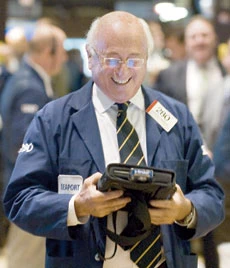
JEDDAH/NEW YORK: Global stocks rallied yesterday, with European shares notching their biggest gain ever, as a US plan to unwind a deadly credit crisis bolstered investor confidence and sent such safe havens as bonds and gold sharply lower.
The yen fell to a 10-day low against the dollar as US authorities moved to thaw seized-up credit markets that had caused equities to tumble and had boosted risk aversion around the world.
Gold futures in New York dropped 4 percent in heavy profit-taking and the price of European and US government debt slumped after Washington said it was crafting a sweeping program to tackle toxic bank assets that have choked the financial system.
The stock rally added to sharp gains on Thursday, which had marked the best day on Wall Street in six years. Europe’s leading share index surged 8.19 percent, its biggest one-day percentage gain on record.
Financial stocks in the US and Europe led the charge. UBS surged 31.66 percent, Barclays advanced 29.24 percent and HBOS jumped 28.91 percent in Europe.
In the US, Goldman Sachs gained 25 percent, Citigroup jumped 24 percent, Merrill Lynch rose 25 percent, Bank of America soared 36 percent and Wachovia climbed 32 percent.
US Treasury Secretary Henry Paulson called for the US government to spend hundreds of billions of dollars to take toxic mortgage assets off the books of financial firms to restore stability in battered capital markets.
“This is a pivotal moment for America’s economy,” President George W. Bush said in a statement, as US officials began acting on a series of government steps. “Our system of free enterprise rests on the conviction that the federal government should interfere in the marketplace only when necessary.
“Given the precarious state of today’s financial markets, and their vital importance to the daily lives of the American people, government intervention is not only warranted, it is essential.”
In full crisis mode yesterday morning, the Treasury said it would guarantee US money market funds to stem a run on deposits that could further destabilize the battered financial sector.
A Treasury statement said Bush approved the use of up to $50 billion to guarantee for the next year the deposits which are widely held by Americans in mutual funds and brokerages, if the firms pay an insurance fee.
According to the financial industry, US firms hold some $3.4 trillion in money market funds, which are generally considered safe investments although they have not up to now been federally guaranteed.
While commenting on the latest financial crisis, Said Al-Shaikh, chief economist at Saudi Arabia’s National Commercial Bank (NCB), said in a statement, “The loss incurred by the current global crisis and its knock-on effect will be between $600 billion to $1 trillion.”
He added: “The crisis triggered by Lehman’s bankruptcy is bad, but could worsen because the past three quarters, beginning in the fourth quarter of 2007, indicated a declining global economy with no clear picture of the future.”
Al-Shaikh said the direct impact of this crisis on Gulf banks, either through transactions or with products sourcing from these affected institutions, have remained limited until now. No doubt there are impacts on some of the institutions or individuals in the Gulf region who have been doing direct transactions with institutions that have failed or have been bailed out.
John Sfakianakis, chief economist at SABB (The Saudi British Bank), too indicated that the crisis is far from over. He said, “Although markets have reacted in a jubilant way, I’m not convinced that either the financial crisis is close to an end — far from it — or that the US, Europe and Japan are near an economic recovery. The measures taken by the US Treasury are a gamble trying to reverse high risk positions that have been accumulating for years now. The exuberance we saw in the way markets behaved yesterday could be indicative of our location which could be right in the eye of the storm.”
Brad Bourland, chief economist at Jadwa Investment, said “The apparent US rescue plan has calmed the financial markets and that should spread to stronger market performance globally.”
Traders unwound safe-haven positions on hopes the measures would be a watershed event to end the carnage that in two weeks claimed two Wall Street icons, what had been the world’s biggest insurer, and two pillars of the US housing finance market.
US government measures to rid financial institutions of bad assets could add up to $1 trillion, Republican Sen. Richard Shelby said yesterday.
“I figure it will be at least half a trillion,” Shelby, the ranking member of the Senate Committee on Banking, Housing and Urban Affairs, said in an ABC television interview of a plan being put together by US authorities. “But if you look at what the Fed has already done, and the extension of power to Treasury to deal with Fannie Mae and Freddie Mac, I believe we’re talking about a trillion dollars,” he said.
Senate Banking committee chairman Chris Dodd said: “I’ve been here 28 years. To listen to the language of last evening, we maybe were days away from a complete meltdown of our financial system.”
Before 1 p.m., the Dow Jones Industrial Average was up 426.24 points, or 3.87 percent, at 11,445.93. The Standard & Poor’s 500 Index was up 52.80 points, or 4.38 percent, at 1,259.31.
The Nasdaq Composite Index was up 75.93 points, or 3.45 percent, at 2,275.03.
A temporary ban on short-selling in financial stocks, in which investors bet stocks will fall, and the US government’s plans lifted European shares.
The FTSEurofirst 300 index closed up 87.16 points at 1,150.78 points, after rising as high as 1,153.38. The index has fallen 23.6 percent so far in 2008.
The dollar rose more than 3 percent versus the Japanese yen, and the euro gained against the yen as the appetite for risk returned.
The euro rose 0.46 percent at $1.4403. The dollar fell against major currencies, with the US Dollar Index down 0.29 percent at 77.902. Against the yen, the dollar rose 1.53 percent at 107.16.
The price of benchmark US and euro zone government debt dived, with short-dated euro zone government bond yields notching their biggest daily jump in more than five years. The two-year Schatz yield was last up 41.3 basis points at 4.02 percent.
The price of 30-year US Treasury debt fell more than 3 points and benchmark 10-year Treasury notes fell 2 full points. The 10-year US Treasury note fell 60/32 to yield at 3.78 percent. The 30-year US Treasury bond slid 91/32 to yield 4.37 percent.
Oil rose nearly $3 a barrel on expectations the US plan would help battered financial markets.
US light sweet crude oil rose $2.92 to $100.80 a barrel.
December gold futures fell $37.20 at $859.80 an ounce, but spot gold prices rose $12.70, or 1.50 percent, to $859.95 an ounce.
Asian shares jumped overnight, with Japan’s Nikkei share average up 3.8 percent, and MSCI’s Asia-Pacific stock index outside Japan up 5.9 percent. — With input from agencies