
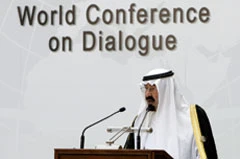
THE international interfaith conference in Madrid, which was held last July at the initiative of Custodian of the Two Holy Mosques King Abdullah, was a big success as it brought together leaders of different religious faiths including Islam, Judaism, Christianity, Hinduism and Buddhism to explore their common values and discuss how to work jointly for promoting world peace and stability.
A man of peace, King Abdullah was convinced that dialogue would help remove mistrust and suspicions from the minds of believers of different faiths and strengthen human unity. “A dialogue which emphasizes what we hold in common as human beings... will make us realize that values and principles uniting us are more than those dividing us,” he said in an interview with La Repubblica, a leading daily newspaper in Italy, on the eve of the Madrid conference.
King Abdullah took the initiative in organizing the Madrid conference to prove that Islam stands for world peace and rejects extremism and violence. “We are a nation with a sublime mission and a deeply rooted cultural heritage. Our religion urges us to embrace the principle of dialogue and to cooperate and coexist in peace with others, and promote understanding, peace, accord and good values among people,” the king told the Italian newspaper.
King Abdullah, who opened the three-day conference, exhorted followers of the world’s leading faiths to turn away from extremism and embrace a spirit of reconciliation, saying that history’s great conflicts were not caused by religion but by their misinterpretation. He also called for constructive dialogue to settle differences. “My brothers, we must tell the world that differences don’t need to lead to disputes,” he told the participants.
“The tragedies, we have experienced throughout history, were not the fault of religion but were caused by extremism, which has been adopted by some of the followers of all religions and all political systems,” he said. “Man, who can be a cause for the destruction of this planet, has the ability of making it an oasis of peace and tranquility where followers of different religions could coexist, respect one another and deal with problems through dialogue and without violence,” he said.
The king added: “This human being is also capable, with the help of God, in defeating hatred with love, intolerance with tolerance and make all of humanity enjoy the benefits of mutual respect...Our dialogue will be a success of faith against atheism, of virtue against vice, of justice against injustice, of peace against conflicts and wars, and of human brotherhood against racism.”
More than 300 delegates attended the global gathering, which was aimed at bringing Muslims, Christians, Jews and followers of other faiths closer together. Participants include World Jewish Congress Secretary-General Michael Schneider and Cardinal Jean-Louis Tauran, in charge of dialogue between the Vatican and Muslims. King Juan Carlos of Spain also addressed the opening session at El Pardo Palace on the outskirts of Madrid.
King Abdullah began his keynote speech reciting a verse from the Holy Qur’an: “O Mankind! We have created you from a male and a female, and made you into nations and tribes, that you may know one another. Verily, the most honorable of you in the Sight of Allah is the one who is most pious and righteous.” (49:13) He thanked participants, who had come from different parts of the world in response to his call, and commended their efforts to serve humanity. “I came from the land of the Two Holy Mosques carrying a message from the Islamic Ummah that declares that Islam is a religion of moderation and tolerance, a message that also calls for constructive dialogue among the followers of different faiths. This message gives glad tidings to mankind by opening a new page of concord, God willing, in place of conflict,” the king said.
The Saudi leader said this message was conveyed by nearly 600 Islamic scholars and intellectuals who gathered in the vicinity of the Grand Mosque in Makkah last month at his invitation to prepare for the Madrid conference. “It is God’s wisdom that people follow different religions. If He had wished He would have united the whole humanity in one religion... We are meeting here today to say that religions should be a means of ironing out differences rather than leading to disputes.” He said religion could combat many of the problems of modern society, including the breakdown of families and drug addiction.
The interfaith conference came after King Abdullah’s historic meeting with Pope Benedict XVI at the Vatican in Nov. 2007. Benedict has said the Roman Catholic Church wanted to pursue inter-religious dialogues that discuss theological differences openly.
Visiting the Lourdes shrine in southwestern France recently, he told French bishops that interfaith dialogue was a vital necessity in a globalized world. “Good will is not enough,” Benedict said. “One must follow closely the various initiatives that are undertaken, so as to discern which ones favor reciprocal knowledge and respect as well as the promotion of dialogue, and so as to avoid those which lead to impasses,” the Reuters news agency quoted him as saying.
UN Secretary-General Ban Ki-moon described the Madrid conference as a symbol of unity among different faiths, adding that he hoped it will contribute to healing divisions and building a more secure and stable world. “This event is itself a potent symbol of unity among different traditions. Our challenge is to see this expression of solidarity turned into a genuine force for good,” Ban said in a message to the conference. He added that the origin of many conflicts lies beyond the confines of faith. “This unique gathering of religious leaders can help debunk the dangerous myth that religion, even when properly understood, inspires violence,” he said, adding that political rivalries, territorial ambitions or competition for natural resources play a major role in triggering violence.
According to Saudi Ambassador to Madrid Prince Saud bin Naif, Spain was chosen for the conference as it is “a natural place for this type of dialogue since for centuries it has been home to members of three of the world’s great religions.” Furthermore, the UN Alliance of Civilizations, aimed at promoting dialogue between different cultures, was the idea of Spanish Prime Minister Jose Luis Rodriguez Zapatero, he added. The aim of the conference was for the leaders of world religions to get to know each other and to look for ways to cooperate, said Abdullah Al-Turki, secretary-general of the Makkah-based Muslim World League, the main organizer of the event.
Saudi Ambassador to the US, Adel Al-Jubeir, said he believed the conference would help reinforce the common values shared by different faiths. “The idea stemmed from King Abdullah’s view that there are universal values that are common to all faiths, and that if we focus on those universal values there is a lot more that binds us as human beings. If we adhere to those values we will be able to overcome adversity, we will be able to achieve peace, we will be able to protect the structure of the family, we will be able to maintain values in our society and our life and essentially make our world a better place,” he said.
The conference focused on four major themes: The importance of dialogue in human society; the foundations of religious and civilizational dialogue; the common human aspects in dialogue; and the evaluation and promotion of dialogue. Well-known theologians, political scientists, and sociologists working on issues of international cooperation, human rights, security, peace and coexistence were invited to present papers and take part in discussions. The final declaration issued by the conference rejected the notion of the so-called “clash of civilizations” and warned against the danger of campaigns seeking to deepen conflicts and destabilize peace and security.
The conference also called for an international agreement to combat terrorism and enhancing common human values and for their dissemination within societies. “It emphasized the need to promote a culture of tolerance and understanding through dialogue by holding conferences and developing relevant cultural, educational and media programs,” the declaration said. The participants said the deepening of moral values and ethical principles would help strengthen stability and achieve prosperity for all humans. Governmental and nongovernmental organizations have been urged to issue a document stipulating respect for religions and their symbols, prohibition of their denigration and repudiation of those who commit such acts.
Muhammad bin Ahmed Tayeb, director general of the Foreign Ministry’s regional office, has called on the United Nations to adopt the resolutions taken by the Madrid conference as working plans for its various organizations. “We consider this interfaith conference as a turning point in history. It reflects the vision of King Abdullah who wants to promote constructive dialogue among followers of different religions for the benefit of humanity,” Tayeb told Arab News. Tayeb said the conference’s success would depend on how the world responds to King Abdullah’s great initiative and how it seizes the momentum set in motion by the Saudi leader.
For Mustafa Ceric, the mufti of Bosnia, the conference was aimed at saving mankind from total destruction. “Over the past 200 years, Muslims have been living in a state of anguish. About 70 percent of the refugees of the world are Muslims. Most of the wars are being fought in Muslim lands though they do not initiate any attack on others. On top of the injustice and humiliation meted out to Muslims, Westerners link Muslims with terrorism. This contradiction creates a sense of insecurity and discontentment among Muslims,” Ceric said.
Delegates were optimistic that the conference would open a new era in interfaith relations. “It’s a major step,” said Jesse Jackson, the American civil rights leader. “For the king to use his moral authority to convene this session, to work for common ground -- that’s a very big step.” Tony Blair, special envoy of the Middle East Quartet, was equally encouraged. “The king has made a lot of reforms,” Blair said, referring to King Abdullah. “The fact that this conference is happening with the king, and with religious leaders of all different faiths, is significant.” For Rabbi Brad Hirschfield of the National Jewish Center for Learning and Leadership in New York, the conference was like a baby taking its first steps. “On the one hand, it’s the most ordinary moment,” he said. “And on the other, it’s the most important. But what matters is what the baby does next.” Above all, the conference was a big achievement for King Abdullah and Saudi Arabia and a major step toward promoting world peace.

