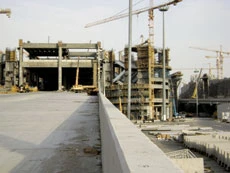
ONE of the remarkable achievements of Custodian of the Two Holy Mosques King Abdullah is the expansion and development of Jamrat Bridge and surrounding areas with the aim of guaranteeing maximum safety to the pilgrims.
King Abdullah opened SR4billion expansion project on Dec. 30, 2006. With the completion of the project, the bridge will have four stories with a total capacity to accommodate 5 million pilgrims per hour.
Currently, the work is under way on the third floor and lower floors are being expanded. Once work is completed in these areas, the bridge will be able to accommodate a total of 360,000 pilgrims per hour. The second floor would be set aside for pilgrims coming from Makkah. The northern and southern inclines would enable pilgrims to enter directly onto the bridge without crossing the courtyard. There is an underground floor too.
The bridge would be about one kilometer in length at all levels. There would be 11 entrances and 12 exit roads enabling pilgrims to travel on separate one-way roads. This will restrict movement in the opposite directions. New tunnels facilitate easy access to buses at the foot of the bridge. The lowest floor would be meant for emergency and first-aid services, utilities and disposal of used pebbles and wastes. The third floor is also designed to make the process of stone throwing less difficult for the sick and the aged. There would also be a surveillance system in place for of the whole area with an early warning system about emergency situations.
The work for the first, ground and underground floors of the bridge were completed in 2006. The second floor was commissioned in 2007 and the third floor will be ready for use before the commencement of Haj, this year. The next phase of the bridge is scheduled to be completed in 2009. Each floor of the bridge would be 950 meters long and 80 meters in width. The bridge will be fully operational by next year.
The stone throwing areas would be constructed in oval shape so that pilgrims could throw stones from all directions. The bridge was designed by the Custodian of the Two Holy Mosques Haj Research Center at the Umm Al-Qura University and the Ministry of Municipal and Rural Affairs. There will also be provision for airlifting of patients at the top of the bridge. Besides, there is arrangement for cold water sprinkling to reduce temperature to 29 degrees Celsius. This would help conditions to remain cool and limit cases of dehydration among pilgrims. The present foundation is strong enough to carry 12 floors. The project also provides for building eating places, saloons, toilets and medical facilities, Civil Defense centers and public security rooms. Cameras would be placed in such a way that every movement in the bridge complex could be monitored at a control room and appropriate preventive action could be taken if required.
Developmental projects worth more than SR14 have been carried out at the nearby Mina over the past 10 years. The new projects which have been designed for the comfort and safety of pilgrims include the construction of a SR385 million intersection connecting King Street and Abdullah Khayyat Street, a Mina drainage project to collect rain and flashflood waters in several small dams in the Moaysem mountains at a cost of SR262 million and another drainage project on the Makkah Holy Sites Road at a cost of SR135 million.
Another major accomplishment of King Abdullah’s reign is the expansion of the Masaa (the walking area between Safa and Marwa) which aims to accommodate 3,840,000 pilgrims daily when completed after three years. The last expansion was made in 1953 with an hourly capacity to hold 44,000 pilgrims.
More than 700,000 worshippers will be able to pray at the same time when the 12,000 additional sq. meters of courtyard around the Grand Mosque is completed bringing the grand total to 300,000 sq. meters.