
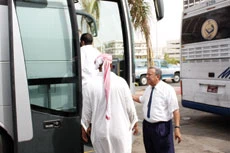
FOR some people traveling by bus around Saudi Arabia, the UAE, Syria, Lebanon, and Jordan might be an exciting way of spending vacation time, but for others like Saudi bus driver Fitani Ali it’s the only way of earning a living. Ali is the third of six children who dropped out of school after the death of his father. He entered the workforce to help his two older brothers support his mother and three sisters when he was only in the sixth grade.
Doing odd jobs, it was hard but Ali was proud that he always managed to contribute to making ends meet for his family. “In those days I used to work on construction jobs or earn a few riyals as a mechanic’s assistant, but most importantly the money I earned was honest — not like so many of the beggars and tricksters you see nowadays plaguing the city streets,” Ali told Arab News.
After working in temporary positions for several years, Ali decided it was about time to find a more dependable means of employment. So he started seeing advertisements for employment in local newspapers. In the meantime, Ali got his driver’s license and applied for a driver’s job in SAPTCO.
“At the time I saw it as a reliable job that would guarantee me a monthly paycheck. I really didn’t have many choices given my poor education,” he said. Ali was lucky to be selected for the job in which he is continuing since 1981.
Now in his early 50’s, Ali is married with four children. He says for him driving a bus is much more than sightseeing and meeting people. Though exciting, it involves self-control, hard work, patience and loads of responsibility.
“I always remind myself while going on a trip that I am responsible for the lives of not only myself, but over 50 passengers,” said Ali. “Not to mention the responsibility assigned to me of taking care of each passenger’s passport and paperwork at border crossings and also assisting border guards with inspecting the bus and its contents during arrival to a new country and on returning to Saudi Arabia,” he said.
“We also encounter situations such as accidents, bad weather and mechanical problems on the road that have to be dealt with patiently and in a professional manner, an exhausting combination indeed,” Ali continued.
He said SAPTCO also makes it mandatory for him to sign in each day whether he is scheduled to drive or not. And on more than one occasions he has returned from an international trip after driving over 24 hours only to be told that he will have to take another group of passengers on a trip to a city within the Kingdom.
He said things have changed a lot in Saudi Arabia. In the early eighties when he joined SAPTCO, it was a social taboo for Saudis to be a bus driver. But nowadays many young Saudis are driving taxis and even working in fish and vegetable markets — jobs usually done by expatriates. “I certainly came under a lot of social pressure with some people treating me as if I was doing something be low dignity or as if I was a foreigner. But I ignored all this and kept in mind the thing that mattered most — the well-being of my family,” he said.
However, according to Ali, the amount of dedication demanded by his peers and employers hasn’t been reflected appropriately in his paycheck. “When I started with the company I began with a monthly salary of SR1,500 and even today — two and half decades later — I have only been given a raise of SR2,500. I give a portion of my salary to my mother. From the rest of the salary I am required to pay housing, food, and utilities,” he said.
Ali, smiling as ever, began to recount to Arab News the day that he thought his hard work had finally paid off but was instead met with something he had never expected.
“One day, I was told that the administration at SAPTCO wanted to see me for giving me reward. The reward was to be for being the only one to have never gotten a traffic citation or been involved in an accident. I honestly thought they were going to give me a raise in salary. I started calculating how I would pay back my debts and buy my family some gifts.
“Instead, the reward turned out to be a newer bus and a two-week training program of driving the new model. I was shocked and disappointed.”
Asked what his family thinks of his job, he said his wife and children rarely see him because he is always on the road. It is particularly tough during Ramadan, Haj and the two Eids when he is also required to be on call. “Of course my family doesn’t like the job I am in but they also have to remain patient because they know how important it is for our well-being,” he said.
Even though Ali is happy to be in job, he would like to join any other company which could guarantee him better prospects. “I would like to work for a company that could offer me a higher salary and could allow me a more flexible schedule in order to be able to give more time to his family and a better life to my wife and children,” he said.