
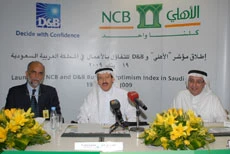
JEDDAH: A business optimism survey has revealed the Saudi economy’s resilience in the face of the global financial crisis.
“The Kingdom’s economy is upbeat on sales volumes and profit outlook and inflationary pressures are expected to stabilize,” Rajesh Mirchandani, CEO for South Asia, Middle East and Africa, Dun & Bradstreet South Asia Middle East Ltd. (D&B), said in his presentation to the media at the National Commercial Bank (NCB) headquarters here yesterday.
The event was also marked by the release of the first edition of the Business Optimism Index (BOI) for Saudi Arabia for Q1, 2009 by D&B, a financial data and business information provider, in association with the NCB.
While inflation remains a key business concern, the results of BOI survey on Saudi Arabia indicate that there are signs of easing inflationary pressure. Commenting on these findings NCB’s Senior Vice President and Chief Economist Said Al-Shaikh said: “The Kingdom has been witnessing significant inflation in the past few years due to abundant liquidity arising out of oil export revenues, strong domestic demand, rising commodity and food prices, and a weak US dollar. The global economic slowdown has caused food and commodity prices to retreat, and the BOI survey indicates that almost a third of businesses in the non-hydrocarbon sector expect their selling prices to fall, and 35 percent do not expect any change in the level of their selling prices. Expectations indicate that we will see a very gradual easing of inflationary pressure in the next quarter.” “Even though the global economic slowdown will impact Saudi Arabia’s business community, the effect will not be as vast as in the Western economies,” Mirchandani said. The results of the BOI survey reflect the resilience of the Saudi economy in face of the global financial crisis. The BOI survey shows that backed by high sales and profit expectations, 41 percent of companies polled have said that expenditure on business expansion will be their leading investment outlay during the next quarter. An additional 46 percent of business units also plan to invest in technology and machinery, signaling that the Saudi business community has got strength to withstand the short term turbulence in the global economy.”
Asked how reliable were the survey and its conclusions, Mirchandani said: “There are many agencies providing such surveys, but it all depends on the methodology used in them. Our survey covered 500 business entities and the methodology we used helps us to reach reliable conclusions.”
As the latest addition to D&B’s global series of BOIs, the BOI on Saudi Arabia, done in association with the NCB, will be issued on a quarterly basis and will be one of the most effective ways to keep track of where businesses think the Saudi economy is moving. The next BOI on Saudi Arabia will be released in April 2009.
The business optimism survey for Q1, 2009 was conducted in November 2008 amid a scenario of an economic slowdown in most of the developed countries, Mirchandani said.