
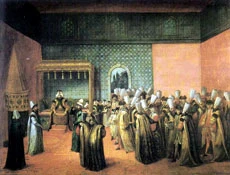
MASTERPIECES of decorative arts from the golden age of the Ottoman Empire are currently on display at Milan’s Sforza Castle. “From Turkey: A Selection of Ottoman Works in the Sforza Castle Collection” exhibits objects never before shown to the public.
Sforza Castle, one of Milan’s landmarks, is a beautiful complex with a long and colorful history. It was originally built in the 14th century as a fortress and an elegant palace by Galeazzo Visconti II and his descendants.
In 1450, during the Italian Renaissance, the Sforza dynasty gained control of Milan. They expanded the castle and made their court one of the most magnificent in Europe, graced by great artists, musicians, and thinkers. Leonardo da Vinci, architect Donato Bramante, and poet Niccolo da Correggio were among the creative talents at the Sforza court.
The castle became a symbol of the Sforza dynasty’s power and influence, reflecting the wealth and sophistication of the city itself. Since the Middle Ages, Milan had prospered because of its strategic location on the fertile plain of the Po, and its proximity to trade routes through the Alps to northern Europe.
Many artists and craftsmen were employed by wealthy Milanese merchants. The city also had flourishing textile and silk industries, ancestors of today’s world-famous fashion houses.
By the 16th and 17th centuries, wealthy Milanese admired and collected luxurious fabrics as well as the ceramic art of the Ottomans. Political and commercial contacts between the Dukes of Milan and the Ottoman Empire had brought carpets and other finely-crafted Turkish art objects into Italy.
The Ottoman Empire reached its peak of splendor and refinement during the reign of Sultan Suleiman the Magnificent, who ruled from 1520 to 1566. At that time, the empire spanned three continents, Europe, the Near East, and Africa, and dominated the Eastern Mediterranean.
The Ottoman rulers were known as sultans, a word derived from the Arabic sultah, meaning “authority” or “power”. The Ottoman sultan’s court, or divan, was known in the West as the Sublime Porte. Originally, the Sublime Porte, or Bab-e Ali, was the elaborate entrance gate to the paved outdoor court near the Grand Vizier’s office in Topkapi Palace, where the formal greeting ceremony for foreign ambassadors was held. Over time, the symbolism of the words Sublime Porte came to include not only the impressive Ottoman court, but also the Ottoman Empire’s position as a gateway between Asia and Europe.
The objects on display in the Sforza Castle exhibit transport the visitor to the refined world of the Ottomans. The ceramics, carpets, and other textiles from various places in the empire show the delicate motifs and the excellent craftsmanship for which the Empire was known.
Europe’s fascination with the exotic charm of the Ottoman world can be seen in several original engravings of Istanbul and the sultan. The luxury of the sultan’s lifestyle, and the extent of his powers and dominion, were frequently exaggerated.
A selection of ceramic tiles, most produced in Damascus in the 16th and 17th century, illustrate the varied components of the renowned Iznik style. Vases, tulips and carnations were traditional Turkish motifs. Clouds, ribbons, and peonies attest to the lasting influence of ancient Chinese ceramics. Floral and animal motifs, including a unique set of tiles featuring a pair of parrots, complete the collection. The well-researched written commentary accompanying the pieces explains regional variations, such as the Syrian preference for an aubergine-purple color in place of the traditional Iznik red.
Three velvet pillow covers, produced in 18th-century Turkey, feature some of the same floral motifs as those on the Syrian ceramic pieces, highlighting the consistency of the Ottoman style through varying materials and different geographical locations.
Central to the exhibition are five Ushak carpets, examples of a style that has been highly sought after in Europe from the Renaissance onward. Seen in Italian cathedrals, palaces, and wealthy private homes, Ushak carpets became familiar status symbols. After appearing in portraits by master painters such as Lorenzo Lotto and Hans Holbein, they began to be known as “Lotto carpets” in southern Europe, and “Holbein carpets” in the north.
The actual Ushak carpet that appears at the feet of the Virgin Mary in a painting by Gentile Bellini is present in the Sforza Castle exhibition, along with a reproduction of the Bellini painting, and provides a memorable experience for admirers of Italian art.
The entire Islamic collection of the Sforza Castle consists of more than 300 items, acquired through donations, bequests and purchases. The current exhibition is the first step toward a permanent display of the collection in a museum dedicated to world cultures, planned for the Porta Genova area of Milan.
“From Turkey: A Selection of Ottoman Works in the Sforza Castle Collection” continues through April 19, 2009. Admission to the castle grounds and to the exhibition is free.