ISLAMABAD: Gunmen attacked a police training school on the outskirts of the eastern city of Lahore yesterday, seizing hostages, throwing grenades and killing at least 11 people before being overpowered by Pakistani commandos.
Six militants were arrested and eight died in the eight-hour battle, said Rao Iftikhar, a top government official in Punjab province.
Interior Ministry Secretary Kamal Shah said 89 policemen were wounded and Interior Ministry adviser Rehman Malik said all those taken to hospital were being screened to ensure no militants were hiding among them.
Punjab police chief Khawaja Khalid Farooq said eight cadets and three civilians were killed. There were some 900 cadets in the school at the time of the attack.
Three of the militants blew themselves up during the final assault and commandos rescued 10 policemen being held hostage.
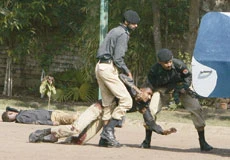
Television channels showed policemen kicking a bearded man on the ground before leading him through a throng of journalists. Reports said the suspect was caught with a grenade in his possession and had an Afghan passport.
Malik later said the man was an Afghan national from Paktika province. He said the attack was sponsored by foreigners with the involvement of people from Afghanistan and the tribal areas of Pakistan.
He said it was premature to link yesterday’s attack with the one on the Sri Lankan cricket team on March 3.
A cadet who fled from the attackers said he heard them speaking a dialect common to southern Punjab. If that account is correct it would point to a nexus between militants from the Afghan border areas in the northwest and Punjabi groups, such as Lashkar-e-Jhangvi (LeJ), that have forged ties with Al-Qaeda.
LeJ was implicated in several assassination attempts on Pakistan’s former president, Pervez Musharraf, and was blamed for a suicide bomb attack on the Marriott Hotel in Islamabad in September.
The attack on the Manawan Police Training School began as hundreds of cadets carried out morning drills. “We were attacked with bombs. Thick smoke surrounded us. We all ran in panic in different directions,” said Mohammad Asif, a wounded cadet taken to hospital. He described the attackers as bearded and young.
Another trainee, Ahsan Younus, said some of the attackers wore police uniforms and took several police hostage.
Frightened police officers were seen jumping over the wall of the center to flee. Some crouched behind the wall of the compound, their rifles pointed toward the parade ground where police said the attack took place. Farther back, masses of security forces and civilians monitored the tense standoff, taking shelter behind security and rescue vehicles.
The forces had surrounded the compound, exchanging fire in televised scenes reminiscent of the militant siege in the Indian city of Mumbai in November and the attack on Sri Lanka’s cricketers in Lahore.
“The eight hours were like eight centuries,” said Mohammad Salman, 23, one of the hostages. “It was like I died several times. I thought it was all over.”
British Foreign Secretary David Miliband was the first foreign diplomat to condemn the attack and pledged help.
“The attack is yet another reminder of the threat that Pakistan faces from violent extremism. It is a threat that the international community must help Pakistan to tackle, in the interests both of Pakistan’s people and of wider stability,” he said in a statement.
Pakistan has endured scores of suicide bombings and other attacks in recent years, and it faces tremendous US pressure to eradicate Al-Qaeda and Taleban insurgents on its soil. Yesterday’s attack occurred close to the Wagah border with India.
— With input from agencies