
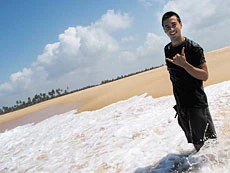
As the sun dissolves into a mellow blend of peaches and the sea stills itself, frowning at the last set of rebel waves that follow each other to shore in quick, defiant succession; it is easy to see how surfing can be meditative. The board is perfectly buoyant as you center yourself on it, relaxed, watchful, studying the surface, feeling the suction of the undercurrent, waiting to catch a wave as it reforms, hoping to harness the energy as it surges through the white water.
Turn off the highway, 40 minutes from the airport, past the mosque and into the little town of Mulki, Karnataka. Drive seven more minutes, through the cement clutter of the marketplace, into the verdant fields where villagers grow rice. This twisting lane will leave you at the Mantra Surf Club, India’s first surfing club, complete with wave-worshipping Californians and Indians.
There is a river you have to get past before you can reach the sand bar where the best waves break. The tide is too low to take the boat. We carry our boards to the jetty and paddle out over the river to the sand bar. Then we cross over the mouth of the river where it meets the Arabian Sea and paddle through the current to Swami Point where the waves welcome us.
The board slices through the water as you become one with the river and the board. The experience is something between swimming and being on a boat. Your arms begin to tire. The tide is going out, so you can relax and glide over the glassy river, watching the palm trees give way to thatched cottages at the fishing villages just beyond. But you need to watch in case the current carries you past the river mouth and into the open ocean. We stop at the sand bar to see at what point we can launch ourselves into the water. The waves at Swami Point tantalize us as we take stock of the situation. Paddle hard, says Dustin Ellison (he now prefers to be called Daruka), our surf instructor, as he swims alongside, putting on his fins as he readies himself to steer us past the roiling current.
Breathe evenly. Shape hands into cups. Plunge arms into the water in long, sweeping motions. Plunge, sweep. Repeat. As my biceps begin to feel the strain of the unrelenting current, the board runs aground, safe on the other side.
We survey the scene from the beach, standing between the foaming waves and the emerald tones of the forest on a wide strip of sun-kissed sand that beckons us to forget the waves.
First you learn to balance on the board, and if yoga is your thing, then you’re solid gold. If you’ve never tried to master the hyperactive imp inside your head that makes your thought process function like a pinball machine gone wrong, then it may take a little work. Breathe. Lie on the board. Shift your weight, pulling yourself up, toward the nose. Now paddle out past the whitewater and the shore breaks to where the sea is mellow. Wait there for a wave to heave upward, peeling as it advances, turn your surfboard, paddle hard so your speed matches the velocity with which the water is moving, and ride the rocket all the way to the shore.
Sometimes the wave peels and it passes from under you without the power it seemed to promise. Sometimes you paddle into a wave only to realize it is about to crash on top of you, at which point, slip off the board, push the board away, dive into the wave, and stay in the calm underbelly until it subsides. I learned to do this and trust that my ankle strap would yank the board back to me after staying on my board, clutching at the side rails, swallowing gallons of seawater as wave after wave broke in my stunned face.
“Don’t fight the ocean, you can’t beat it. Understand the power, don’t struggle, submit to it,” said an Australian, the only other person staying at the surf club, who comes to my rescue as I cling to my board. “Let go, and get back on. Don’t be afraid to dive into a wave.”
I think of Daruka’s words: “Feel the wave holding you down underwater? So what? Don’t fight to come up to the surface. Roll with it, and you come right back up. Calm yourself.”
As I balance on my board, the Australian turns me around and says “woah” in the way that surfers will only do when they see a wave forming in the near distance.
“Your wave. Paddle hard.”
I feel him shove the board into the frothing wave as it breaks on top of him. My board is going like a rocket toward shore. I clutch the sides and feel the board being lifted halfway out of the water. I start to paddle, willing all of my strength into my arms. The wave slows and then reforms under me. I slow down twice and pick up speed again as waves merge. I can hear someone shouting and, as wave washes up on shore, I realize it’s me howling with pleasure “wooohoooo-yeah”. An adrenaline rush that beats anything I have ever felt courses through my system.
Back on our boards we wait for the next set of waves. A flock of tiny birds fly over us and around, their feathers turning from white to silver and back as they catch the placid rays of the sun as it surrenders to the sky. The next day we paddle out again, waiting from early light until the sun turns fierce before attempting the right wave as it breaks along the coast.
Elsewhere in Karnataka, extremists appropriating Hindu philosophy are burning churches. In Kashmir, the extremists are claiming their land grab is about liberating Muslims. But here, in Mulki, there is peace.