WASHINGTON: Barack Obama marked 100 days as president yesterday, claiming his ambitious agenda of “remaking America” had begun to take hold.
He began his day with a White House appearance with Sen. Arlen Specter, the veteran Pennsylvania Republican who announced on Tuesday that he is switching parties to become a Democrat; a development the president said he was “grateful” for. Vice President Joe Biden, who had long encouraged his former Senate colleague to become a Democrat, also attended.
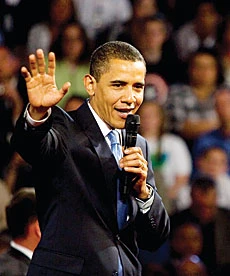
The president then left for a town hall-style meeting in Arnold, Missouri, a suburb of St. Louis, where he not only discussed his first 100 days but also focused on moving his agenda forward. “We have begun to pick ourselves up and dust ourselves off and we have begun the work of remaking America,” Obama told a raucous crowd in opening remarks at the town hall meeting.
“Now, after 100 days, I’m pleased with the progress we’ve made, but I’m not satisfied,” an upbeat Obama added. “I’m confident in the future, but I’m not content with the present,” he added. “Not when there are workers that are still out of jobs, families who still can’t pay their bills.”
Obama returned to Washington in the afternoon and attended a primetime news conference, his third since taking office.
Darrell West, director of governance studies at the Brookings Institution, said the White House is smart to try to take control of the message on the 100th day. “It’s always good to play offense,” West said. “If you create a vacuum, someone else is going to fill it.”
Time will judge all of the decisions that Obama has made during his first 100 days. Confronted with the worst economic crisis since the Great Depression and a nation tired of an unpopular war, Obama set into motion a fast-paced agenda aimed at changing policies, priorities and perceptions on several fronts in his first 100 days in office.
Whether you like him or not, there has been nothing tentative about President Obama’s first 100 days in office. He has defined his presidency by his leadership, the breadth of his ambitions and his determination to push through his programs despite united Republican opposition.
Nationally, he commanded the Democratic majorities in Congress to pass a $787 billion stimulus plan to jolt the economy, while proposing record government spending in a budget that raises taxes on the rich to fund education, health care and environmental programs. He has removed long-held federal funding restrictions on embryonic stem-cell research and on international nongovernmental organizations that perform abortions.
Internationally, Obama has promised to close the US military’s detention center for terrorism suspects at Guantanamo Bay, set a timeline for withdrawing combat troops from Iraq and ordered 21,000 more troops to Afghanistan.
He has faced nuclear threats from North Korea and Iran, eased restrictions on travel by Cuban-Americans to Cuba, and even authorized a shoot-to-kill rescue mission for a US tanker captain held by Somali pirates.
In terms of leadership style, Obama at times has seemed a combination of his two most recent predecessors.
Like Bill Clinton, he is intellectually curious, philosophically flexible and eager for input. Like George W. Bush, he is disciplined, willing to delegate and comfortable with bold decisions.
During his first three months, Obama has struggled to avoid the isolation that besets so many leaders. Upon taking office, Obama set up a group of outside economic advisers to provide him with an array of opinions.
“He doesn’t want to get insulated,” said one White House official.
One way to avoid insulation is to get outside Washington.
Spending at least part of his 100th day on the road was keeping in step with Obama’s penchant for getting out of Washington. While debate raged on Capitol Hill over his massive economic stimulus bill, Obama took his case directly to the American people, holding town hall meetings in Indiana, Florida and Illinois.
When Congress passed the bill, Obama opted out of a White House signing ceremony, choosing instead to sign the bill at a Colorado science museum.
Given all the activity, Obama’s first 100 days have often been compared to those of President Franklin D. Roosevelt in 1933.
But historian David M. Kennedy, who wrote a major work on the Depression, told reporters that Obama’s opening months differ from Roosevelt’s in one important way.
“They are putting things on the table now that are very comprehensive changes of the sort that Roosevelt didn’t bring forward for a couple of years,” Kennedy said.
“Roosevelt had a general idea of what he wanted to accomplish, but it took him a while to put it all together,” he added.
Obama’s appetite for governing is clear from the way he has talked about the presidency; aides say his goal is to be a transformational president.
His most revealing comments came during an interview last month: “I think that we are at an extraordinary moment that is full of peril, but full of possibility,” Obama said. “And I think that’s the time you want to be president ... This is when the political system starts to move effectively.”
Both Obama and his wife, Michelle, are doing very well in public polls. Michelle, a political rock star and fashion sensation worldwide, has impressed Washingtonians as a down-to-earth woman who has the interest of the people at heart.
Together or separately, the president and his wife have been seen out and about in Washington, and have spent considerably more time than their predecessors in the low-income neighborhoods.
The Obamas have staged events at public schools and community centers.
On the service day held before the inauguration, he wielded a paintbrush at Sasha Bruce Youthwork, an emergency shelter for teens; last month she dished out risotto to the homeless at Miriam’s Kitchen.
“It’s been nothing short of incredible,” says Washington’s Mayor Adrian Fenty.
“It’s really an unprecedented level of energy and commitment to Washington, D.C., and the issues that are important to the people who live here. It brings an excitement to this city that I haven’t seen before, and I’ve lived here my whole life.”