ISLAMABAD: Thousands of people yesterday fled Pakistan’s war zone in the country’s northwest amid fierce fighting between the Taleban and government troops that killed at least nine soldiers and the son of Sufi Muhammad, the man who negotiated a controversial peace deal.
Kifyatullah was killed by security forces in Lower Dir late Wednesday, said Ameer Izzat Khan, a spokesman for Sufi Muhammad. The exact circumstances of his death were not clear.
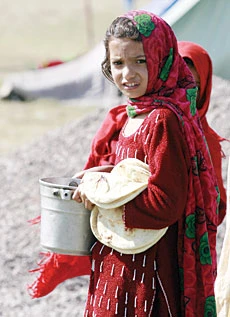
Yesterday, several thousand men, women and children — most riding cars, buses and tractors, but some of them on foot — took advantage of an easing in the army curfew to pour through Swat’s main town, Mingora, in search of safety.
The ramshackle convoys were rolling up hours later at a string of camps set up by the government and the United Nations in the city of Mardan and neighboring towns. Hospitals in Mardan treated dozens of civilians, including children, with serious gunshot and shrapnel wounds.
At the Tuberculosis Hospital in Mardan, hundreds of the displaced jostled before desks manned by hard-pressed volunteers to register for tents and handouts of emergency supplies.
Yar Mohammad, a 50-year-old stone mason, said he had “poured his blood” and his best years into the development of Swat, once a haven for tourists drawn to its Alpine-like scenery.
“Now I am seeing the buildings that I have helped to construct being blown up and destroyed,” he said, blaming both the Taleban and the authorities. Some residents complained that the Taleban had blocked their escape.
Ayaz Khan said he loaded his family into his car in the Kanju area of Swat only to find rocks, boulders and tree trunks laid across the roads, forcing him to turn back.
“I am helpless, frustrated and worried for my family,” he said by telephone from his home.
A militant commander in Maidan, Mifthahuddin, claimed that they had killed at least 12 soldiers in Gumbar and their bodies were lying in the bazaar.
But the government said nine soldiers were killed, seven in one ambush, during clashes over the past 24 hours in Swat. “In 24 hours, we lost nine soldiers and about 10 of them (were) injured,” said Maj. Gen. Athar Abbas, the military spokesman.
In a televised address to the nation, Prime Minister Yousaf Raza Gilani said his government was left with no choice but to act “to save Pakistan.” He accused the militants of going back on the Swat peace deal.
“We signed the deal in accordance with the aspirations of the people of Pakistan and enacted legislation in order to bring peace and restore education and health facilities in Swat … (but) We are sorry to say our goodwill gesture was taken as our weakness. Militants violated the Swat peace treaty and instead they further spread their activities.”
The prime minister also charged the militants with practicing un-Islamic acts to defame Islam. He appealed to the nation to support the armed forces that have been charged to root out militancy.
US Defense Secretary Robert Gates praised Pakistan for its “strong response” to the Taleban advance that he called a significant danger to the government.
US officials have long urged Pakistan to take a tough line against the militants, who are based in the west of the country near the Afghan border.
Pakistan’s President Asif Ali Zardari assured US President Barack Obama in Washington on Wednesday of Islamabad’s commitment to defeating Al-Qaeda and its Taleban allies.
Speaking at a news conference during a visit to neighboring Afghanistan, the US defense chief said Taleban militants had “overreached” by attacking the Buner district, adjoining Swat, coming within dozens of kilometers of the capital Islamabad.
“I think it has served as an alarm for the Pakistani government that these violent extremists in the western part of Pakistan are a significant danger to the government of Pakistan,” he said. “I personally have been very satisfied with the strong response that the Pakistani government and army have taken in response to this.”
Gates also said he thought there was “very little chance” of the Taleban being able to seize control of Pakistan’s nuclear weapons, a threat that had made headlines in the United States.
— With input from agencies