
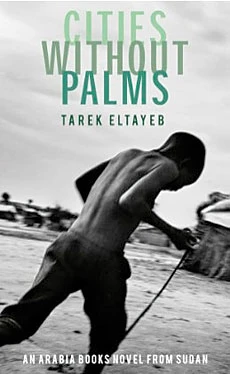
For many years Tayib Salih, author of the memorable “Season of Migration to the North” published in 1967, dominated Sudanese literature. In the last decade, however, two authors have appeared on the literary scene, Leila Aboulela, the award-winning novelist who wrote “The Minaret” and Tarek Eltayeb. His first novel “Mudun Bila Nakhil” — Cities Without Palms — was originally written in Arabic in 1992. Its English translation by Kareem James Palmer-Zeid has just been published by the American University in Cairo Press.
“Cities Without Palms” is the story of a young man, Hamza, who decides to leave his native village, Wad Al-Nar, in order to provide for his mother and young sisters. His odyssey which takes him to neighboring Egypt and then Europe, reminds us of the author’s own life.
Tarek Eltayeb was born in Cairo in 1959 to Sudanese parents. He lived in Ain Shams, one of the city’s oldest districts. After obtaining his Bachelors in Business Administration, he worked as an accountant, and then in 1984, he left for Vienna to continue his studies. At the same time, he began writing in Arabic: “It helped me to get over loneliness and home sickness. And later on, it proved a way to find myself. After my first short story had been published in London in an Arabic periodical, I realized that writing was part of myself.”
Tarek Eltayeb remained in Austria; he is currently teaching at Karl Franzens University in Graz but Hamza, the young protagonist of “Cities Without Palms” chooses to return home. In the novel’s first pages, the author describes in striking words the tragic plight of the poor children living in Wad Al-Nar: “Most of them just play in the sand, naked as the day they were born. This is the new generation, a generation molded by the pain of poverty and famine. Day after day, their bodies fill with dirt. New diseases creep into them with each passing hour. Death advances on them like a serpent on an injured bird, a bird that long ago lost the gift of flight. We need medicine as much as we need food, and we need food more than knowledge. Hunger has spread from our stomachs to our minds, and now our heads are filled with it. How can they expect us to learn like this?”
For Hamza, they have become “the living dead”. Despite their sad predicament, Hamza is not even able to shed a tear: He has become as dry and desolate as his native village. He believes there must be a better place and his dream for a better future takes him first to Egypt, then to Italy, France and finally Holland. In Europe, he experiences the harsh realities of life as an illegal immigrant.
The author acknowledges that one of his favorite subjects is how human beings adapt to foreign surroundings in which they feel lost. How can they fit into a different society without giving up their own personality?
“Cities Without Palms” is written in the first person: “The most true-to-life form, giving you the possibility of describing bad features of a person without judging that person from a superior point of view,” explains Eltayeb.
In this first short novel, the lack of details is in stark contrast to the author’s writing habits. Eltayeb is well organized: He keeps a file-card box where he records his ideas and he always has some paper for notes: “I use notebooks, big ones for everyday and little ones when I travel. I write every day, not at fixed hours, but I prefer the evening, starting about six or seven, and my best time is late in the evening or sometimes even in the night,” says Eltayeb.
This short novel suffers from a lingering sense of aimlessness which reaches its climax at the end. After a year and a half spent abroad, the young hero’s return home to Wad Al-Nar is unclear. Hamza fled poverty only to return to his village which has turned into a graveyard. Wad Al-Nar has become unrecognizable and the graveyard is buried under sheets of sand.
At the beginning of the novel, we read how Hamza felt safe among the graves where he used to sing for hours. But with the loss of his mother and sisters, the thought of graves becomes a source of pain, unleashing a torrent of grief: “ ... I cry, I weep until the echo of my shrill lamentation fills the place. And I hear the dead crying with me.”
Unlike his young hero facing a tragic reality, Tarek Eltayeb can look forward to a promising future. His raw talent needs to be refined but the gift and passion for writing are there.