
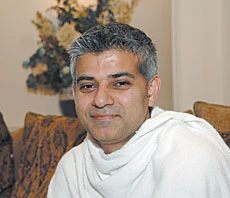
Sadiq Khan is an extremely able and personable 38-year-old modern Muslim minister. This week Khan became the first UK minister or western politician of equivalent rank to enter Makkah and Madinah. Disarmingly direct in his rapid-fire conversation and with a moral drive, evidenced by his record as a human rights lawyer, he radiates an air of cultured competency without being saponaceous.
Born and raised as the son of a bus driver in London, Khan grew up in a council flat on the Henry Prince Estate in Earlsfield, attended Fircroft and Ernest Bevin Schools and read law at the University of North London. Currently he is Labour MP for Tooting, Minister for Cohesion and Faith and Parliamentary Under Secretary of State for Communities and Local Government.
Dressed in ihram between Madinah and Makkah ready to perform Umrah, he reflected on the publicity surrounding his visit.
“People use the words ‘landmark’ and ‘historic,’ but to me it simply reflects the UK, the modern society,” he said. “It illustrates the relationship and demonstrates what the UK in the 21st century is about. We have a government in which there are members of the Muslim faith representing the two million Muslims out of a UK population of 60 million and who have been very successful in various walks of life.”
Khan’s visit, apart from the diplomatic implications of furthering good and friendly relations, sought to capitalize on his unique position as a UK Muslim minister by bringing the focus of a British Muslim to bear on the approach to terrorism. He was at pains to emphasize that his visit was to “improve people-to-people links as well.”
In Riyadh, Khan visited Imam Mohammad bin Saud Islamic University and met the Minister of Islamic Affairs.
“One of the motivators used by young criminals when it comes to encouraging themselves for terrorism is theology,” he said. “They justify their actions by using a perverse interpretation of Islam. The Ministry of Islamic Affairs is very fortunately rebutting that.”
The meetings were to discuss to see what work the UK government could partner with them.
“They are already working with British universities and already have good relations with the UK,” he said, noting that there were students from more than 150 countries — including 43 students from the UK — at Madinah University.
“People around the world look on Madinah in a special way and it’s very important that we work with them to make sure the young people in the UK learn the right form of Islam.”
Khan amplified his observation on “the right form”.
“In Islam you can have many forms of thought with different sects. There is no issue there. The issue comes when an individual or a group tries to justify acts of terror using a perverse interpretation of Islam.”
He continued; “I met the imam of Madinah and leading clerics here. They are quite clear and unequivocal: There is no place in Islam for those views and that behavior.” Khan criticized the act of takfir, when a Muslim labels another Muslim as an infidel because he doesn’t share the same school of thought.
“It’s not for me or you to say which school of thought is correct or whether a Shiite is better than a Sunni or a Hanafi is better than a Shafi. What we are able to say is that this is wrong and the good thing is that leading Muslims in Saudi Arabia agree: It’s wrong.”
Turning to his portfolio as minister for cohesion and faith he described its remit as “basically intercultural relations and building bridges between communities.”
He was quick to point out that intercommunity relations were not the same as integration.
“I don’t want your wife or my children to lose their sense of identity, whether it’s race, faith or gender, but we have to accept, and it’s a source of pride, that we have lots of things in common,” he said. “So where there can be bridges we should encourage those bridges to take place and make sure that young people grow up with a sense of citizenship and a sense of pride in their communities.”
Khan said there were challenges or opportunities depending on one’s viewpoint.
Two thirds of British Muslims are below the age of 35; half are below 25 and a third below 16.
“We want to make sure that our young citizens of whatever race or faith have the knowledge and the wherewithal to withstand radical preachers of hate and to get on with their neighbors,” he said.
Finally acknowledging the elephant in the room, we turned to the question of the revelations concerning the egregious expense claims by some MPs in the UK.
“I don’t necessarily accept that politicians in 2009 are any more immoral that in the past,” he said, adding that politics and politicians could inspire people — young people especially — to do great things.
“Politicians are a source of good, and that’s why I feel that the way some MPs are paid in the UK is disgraceful. Actually, the fact that it [expense claims] is not unlawful and within the system is not good enough”
He said that he felt battered and bruised seeing the way his profession was treated by the media and the public.
“However, I think the public have every right to be angry with politicians. I think some politicians have behaved disgracefully. My concern is that we will have a generation of young people who say, ‘Why should I bother voting? Why should I trust you as a politician because you’re all the same?’”
Khan said there was a huge responsibility on politicians to find those MPs who had acted disgracefully.
“Those MPs, frankly speaking, should not be MPs,” he said.
Equally important was for the House to try to win back the trust and confidence of the British public: “It will be a long and slow process.”
Politicians also make and police the rules and that begs the question; “Quis custodiet ipsos custodes? (Who guards the guardians?)
“That’s a big point and I think the vitriol, anger and sense of betrayal from the public is fully justified,” said Khan. “I think we should inspire the public, should be inspirational and be above reproach — and we’re not.”