
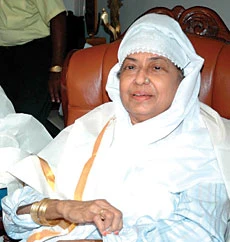
Madhavikutty alias Kamala Das alias Kamala Suraiyya dared to live her life to the call of her inner world. This most illustrious writer who established her own fiefdom in Indo-Anglican and Malayalam literature seldom bothered about the commotion her actions created. Blunt and provoking innocence was her forte and controversy was her playmate. K.R. Meera, a young contemporary from the Malayalam literary scene said of her: “She lived the life I dreamed of but dared not.” The Indian literary world envied her fearless freedom and tolerated her with veiled jealousy.
She died of cancer in Pune, the cultural capital of Maharashtra; her mortal remains were brought to Mumbai, her home for decades, at the request of her readers and admirers who lined up to pay homage. Kerala’s Minister of Education and Culture M.A. Baby accompanied her on her last journey to Kerala, her birthplace, which she preferred as her final resting place. The sheer number of literary enthusiasts and ordinary people who lined up throughout the route to the state capital to pay their last respects to the controversial writer has amazed even her hardcore critics. Visual and print media revolved around her with reverence for days.
Madhavikutty, born to aristocratic upper caste Hindu parents, embraced Islam toward the evening of her life and wished to be buried at the Juma Masjid cemetery in Kerala’s capital, Trivandrum. Her sons, despite pressure from Hindu fundamentalists, firmly went on with the plan to give their mother an Islamic burial of her choice. It failed to provoke any kind of protest in Kerala and the fact that a massive number of Hindus chose to attend the burial amplified Madhavikutty’s popularity and acceptance.
She was short-listed for the Nobel Prize on the strength of her poetry collection “Summer in Calcutta” and later won the Asian Poetry Award. She served as Illustrated Weekly’s poetry editor for a long period and was a leading activist and socialite throughout her life. Her Malayalam writings won almost all kinds of literary recognitions including the prestigious state and central academy awards, Ezhuthachan Puraskaram and Vayalar Award.
Her writings, like her life, were also sensational. The most controversial that shocked even her ardent readers was her memoirs titled “My Story.” It was a kind of bare-it-all personal reminiscences about everything, including her intimate relationships with men outside her marriage. Originally published in English, “My Story” was later translated into Malayalam. It created a kind of literary hurricane and the Indian orthodoxy was up in arms against her. Madhavikutty later said that it was a mixture of imagination, hallucination and reality, and disowned it as an autobiographical work.
Her writings have been translated into almost all Indian languages and into many world languages including English, Spanish, Arabic and Japanese. Connoisseurs of literature rate her short stories much above her poetry. She is considered to be a path-breaker of avant-garde literary sensibilities in Malayalam. When neoclassic socialist realism was having its sway over Malayalam literature, Madhavikutty dared to experiment with a new kind of language — plain, lucid, transparent yet poignant and richly emblematical. Her stories portrayed the inner self with poetic accuracy but on the whole lifted the story to a metaphorical level, rich with universal relevance. “Pakshiyude Manam” (The Scent of Bird) is such a story. It is considered to be one of the best stories written in Malayalam, matching world standards.
Her writings in general echoed rebellious inner conflicts of an educated Indian middleclass woman trying to free from the chains of orthodoxy. She was emotional, impatient and honest to the core. Hence, in a way, her innocence was provokingly original. She was a wounded nightingale that preferred to fly the eagle’s path. Undoubtedly, the emerging generations of new Indian women will find her worthy to celebrate as an icon of freedom and individuality. Certainly, the legacy of Kamala Suraiyya is here to stay beyond the predictions of any conventional establishments.