
Inefficient delivery systems for agriculture and high volume of usage are by far the biggest waster of water in the Kingdom.
In his 2005 Ph.D. dissertation at London University’s School of Oriental and African Studies, Elie Elhadj said that “between 1994 and 2005, while the overall irrigated surface declined by 31 percent, from 1.6 billion hectares in 1994 to 1.1 billion hectares in 2005, water used in irrigation was reduced by 13 percent only, from 20 billion cubic meters in 1994 to 17 billion cubic meters in 2005.”
Using existing technology, that amount could be reduced further by between 40 and 90 percent. Reducing agricultural water consumption just 10 percent equals the amount used for domestic and industrial purposes, yet the technology exists virtually unused in the Kingdom.
There are however other areas of society where savings can be made, from measures as simple as reducing the volume used in a toilet flush by installing a lower volume flush system (or simply putting a plastic bag pre-filled with a few liters of water in it into the toilet tank) to eliminating the culture of compulsive car-washing and patio-hosing.
Education introduced into the national curriculum at an early stage would establish in citizens a life-long sense of responsible water consumption. Another factor is economic: A realistic charge for water for domestic consumers might well encourage reduction in use. A state water subsidy of over 90 percent is perhaps not the best route to encouraging anything but profligacy. The price of a tanker truck full of water for domestic delivery in Jeddah costs SR250 ($67).
Much of Saudi Arabia's domestic water is delivered in tankers. In Saudi Arabia the public pipe network for delivering water to private residences is limited in its coverage. In April 2008 Veolia was contracted to install a water and wastewater system for Riyadh's 4.5 million inhabitants. The drinking water network will total 10,000 km and wastewater network 4,500 km, according to Minister of Water and Electricity Abdullah Al-Hussayen.
The contract was brought about by the simple fact that pipes leak. A 3mm hole in a metal pipe, at 40 psi, leaks 10,000 liters of water in 24 hours. A leak the size of a pinhead can waste 1.3 million liters per year, enough to fill 12,000 bathtubs.
Al-Hussayen estimated leakage rate at 20 percent for the Kingdom as a whole with 90 percent of that in networks for private homes. At the signing of the Veolia contract, the minister was quoted as saying: “There is an urgent need to reduce water leakage, which invariably amounts to nearly 50 percent of total water supply.”
Just this week, Al-Hussayen announced funding of SR1 billion to address the problems of leaky water networks. Concern is mounting and action is being taken.
Peter Vincent in his environmental overview of the Kingdom in the same year stated the loss rate was 50 percent in Madinah. Muhammad Habeeb Al-Bukhari, an expert at the Water Research Center of King Abdulaziz University in Jeddah, has estimated the amount of water leaked from the pipelines at 35 percent of the total supply.
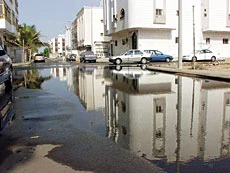
He said: “We have to stop leakage of water by installing new pipelines before urging the public to conserve water.” He added that water leakage would not only affect buildings but also lead to the spread of diseases such as dengue fever in the city. (Standing pools of water from leaks and from personal improvised storage containers are breeding grounds for mosquito-borne disease.)
The simple truth is either no one really knows how much water is being lost, but everyone agrees it is a substantial amount. All concerned parties agree that water leakage should be minimized as soon as possible. Once again simple and extant technology could be a way forward. A reduction in water pressure reduces the volume of water lost by existing leaks and reduces the possibility of pipe bursts in aging systems.
Regarding the other issue of personal consumption: As long as water remains as cheap to the consumer as it is, there is little economic incentive to conserve it.
The cost of production to the government and the Saline Water Conversion Company (SWCC) might supply sufficient pressure on the supply side. Certainly the right noises are being heard from the authorities and action is under way.
No single technology will provide the magic bullet that fixes all the problems. However, raising public awareness, rainwater harvesting, long-term infrastructure, maintenance and the introduction of a realistic tiered pricing system is likely to have a profound impact on the use of water.
And of course the elephant in the room is agricultural consumption of water. The sooner efficiencies are implemented the better. Water is in effect a finite reserve as the infrastructure position is today in the Kingdom. It really is a matter of “waste not, want not.”