
Bears, honey and how to make biscuits; it is an compellingly attractive recipe for a children’s book and they have all come together in a charming new release in Saudi Arabia, “Honey Biscuits” by Hanane Fathalla. Inevitably there will be comparisons with Pooh Bear — not the sterile two-dimensional Disney version but the para-philosophical observer from the pen of A A Milne.
Zaatar, the central character is however a modern computer generated iteration of the archetypal ursine and has his own unique charm that will surely appeal to young readers as a contrast to technicolour and poorly scripted TV animation derivatives that infest literary material for children.
This bear, Zaatar, is a simple, rather charming and friendly character who exhibits all the right characteristics of a friend and role model. Not that the book is anywhere near instructional; it is a gentle meander through a world of pastel coloured drawings and chatty animal friends to the ultimate pleasure of honey biscuits. It is really a case of; “read the book then eat the plot.”
The story starts as any good adventure does with an unexplained event. Mysterious ladybugs deliver to Zaatar’s door one night an ancient tome that turns out to be the repository for all knowledge of honey biscuits. More importantly there is a recipe. It is the search for the ingredients and the final baking of the golden treasures that forms the plot for the book.
On the way, the reader meets Zaatar’s friends — in particular an obsessively talkative pink bird (Zaqzouka), Abkar a short-sighted worm and Ruusa a tree-climbing cow.
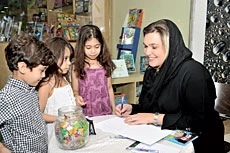
“The whole story started in a creative writing class where the assignment was to incorporate animals as characters into a story,” said author Hanan Fathalla at a recent book launch and signing in Jeddah. She said that she thought up a very simple story line and set about developing characters looking for unusual names and dreamed up Zaatar the Bear. “Bears in real life may be dangerous but in stories they are always cute and furry,” she said respecting a long tradition, “and I wanted to emphasise the values of friendship and teamwork as well.” Oddly, the cookies, which turned out to be the lynch pin of the story’s appeal, came later.
The book successfully achieves the naïveté of a good comic book through the stylised figures and the speech bubbles but avoids the trap of descending into the trivial. The language is easy and simple, though occasionally odd words bring the reader up short and will need explanation; hyperactive, for example.
The book derives a great deal of its charm from the drawings. Originally hand drawn and coloured, Fathalla changed to computer drawn and coloured figures and it worked perfectly. Whilst I have a preference for more traditional illustration, through the use of harmonized pastel colours she achieves a beautiful and refreshing change from the intense cartoon-colours of some publications and makes the characters entirely approachable and unthreatening. Hers is a gentle world but without the chocolate-box fuzziness of dewy eyed kittens. It is in the best traditions of a congenial and non-threatening environment where a child’s active mind can relate to characters on an adventure yet be sure that nothing much nasty is going to happen.
Fathalla thinks there are more books to be written about Zaater — the response since this first one was released in 2007 has been impressive. Since its launch in the Kingdom at Little Book in Jeddah, the uptake looks set to continue.
“I really want to continue the story, but don’t have any ideas now, she admitted, pondering the idea of producing a bilingual version or adding a CD version read aloud.
I road-tested the adventures of Zaater and his chums on some borrowed six year olds; they loved it, especially the glorious mess of flour and honey in the kitchen when making the cookies. What did they taste like? Wonderful — and bear-shaped of course.