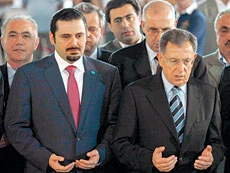
BEIRUT: Western-backed billionaire Saad Hariri pledged yesterday to work for a national unity government including his Hezbollah rivals shortly after he was appointed by the president to become the country’s next prime minister.
An alliance led by the 39-year-old, son of slain former Prime Minister Rafik Hariri, fended off a serious challenge from Hezbollah and its allies in parliamentary elections earlier this month.
Hariri’s nomination — and his conciliatory statements — signal more willingness on the majority’s part to placate Hezbollah and its allies, who had serious misgivings about the previous prime minister, Fouad Siniora.
Many hope it will mark a new start for a country plagued by political turmoil, assassinations and sectarian street clashes in the past four years.
Hariri immediately pledged to work with rivals to form a national unity government to confront economic and security challenges, but he faces tough negotiations with his rivals.
In what appears to be a potential obstacle to a speedy formation of the new government, he indicated that he will not give the Hezbollah-led minority veto power in the new Cabinet. He said he seeks a government “that can achieve, one that is free of obstacles and paralysis.”
Hezbollah and its allies negotiated veto power last year after militants overran Sunni neighborhoods in Beirut and forced the government’s hand. The veto power virtually paralyzed the government but ensured a year of relative calm.
President Michel Suleiman appointed Hariri after two days of consultations with legislators from the 128-member Parliament, 86 of whom named the US-backed politician as their choice for premier, according to a presidential decree.
Hezbollah did not name Hariri or anyone else for prime minister during the meetings with Suleiman. But the head of Hezbollah’s 12-member parliamentary bloc, Mohammed Raad, said Friday that if Hariri was chosen, the group would be “open and cooperative in order to help boost confidence and achieve a national unity government.”
Under Lebanon’s sectarian divisions of political power, the prime minister must be a Sunni, the president a Maronite Christian and the parliamentary speaker a Shiite. Celebratory gunfire erupted in several Sunni neighborhoods of Beirut yesterday following the announcement of Hariri’s appointment, and there were reports of several injuries.
Hariri marked his achievement by praying in downtown Beirut next to the grave of his father, who was killed by a massive truck bomb in 2005. The attack triggered a sea change in Lebanese politics and sparked the younger Hariri’s entry into politics.
The makeup of the new Parliament, almost identical to the outgoing one, means that many of the questions that have dogged the fractious nation, such as what to do with Hezbollah’s arsenal, remain. That could translate into renewed political deadlock in this sharply polarized and volatile nation.