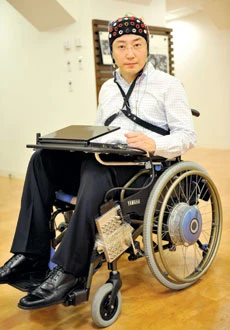
TOKYO: Japan’s Toyota Motor said yesterday it had invented a way to allow a person to steer an electric wheelchair through simple thought, using a helmet-like device that measures their brain waves.
The cutting-edge Brain Machine Interface (BMI) technology uses electrodes attached to the scalp to measure localized brain activity when a user concentrates on certain physical movements.
The signals are displayed on a panel in almost real time and translated into instructions to steer the motorized wheelchair, the researchers said.
“Such systems allow elderly and handicapped people to interact with the world through signals from their brains without having to give voice commands,” Toyota said in a statement.
“This technology is expected to be useful in the field of rehabilitation, and for physical and psychological support of wheelchair drivers,” it added. The company said the system is 95 percent accurate and able to adjust itself to the characteristics of individual users.
“Thus the driver is able to get the system to learn his/her commands (forward/right/left) quickly and efficiently,” said the statement.
Several Japanese laboratories are working on BMI technology to develop new applications to make life easier for the disabled and the elderly.
Japan’s Honda Motor Co. in March introduced the latest version of its celebrity robot ASIMO, which could be steered remotely by another person wearing an electrode-studded helmet through BMI technology.
Honda’s humanoid could perform four basic movements based on the nonverbal instructions of a person.
The company said the research aims to create a robot which can eventually help people, particularly the elderly, with house-keeping chores such as watering plants or serving dishes.