
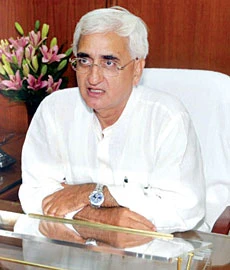
Union Minority Affairs Minister Salman Khursheed has promised to set up on priority the Equal Opportunities Commission, which can mean a quantum leap for the minorities, who often face discrimination and especially the women, who face double-discrimination — both on grounds of gender and religion. It could open up new vistas, as minorities strive for security, besides social, educational and economic development.
In an exclusive interview with Arab News, Khursheed speaks on a range of issues concerning the Muslims and highlights the several measures initiated by his ministry for the welfare of the minorities.
There are protests on subsidy for Haj travel. How do you propose to tackle it?
As for the furor over subsidy for Haj travel, I am thinking, why not resources be mobilized otherwise, so that there is no dependence on government agencies? For instance, a better management and development of waqf property is the bigger challenge. If we manage to do that then probably we can manage our own educational institutions and even help others and mobilize resources for the Haj travel, as also for the social and economic uplift of Muslims, who have been painted as socially, educationally and economically backward by the Sachar Committee Report survey.
What is your first priority as the Minister for Minority Affairs?
I want the Equal Opportunities Commission to be set up within my first 100 days of taking office — that’s my first priority. It will have magisterial powers and can initiate action. The idea is to strike at the root of discrimination bases on gender, religion, caste or language. It is not just for minorities but also for all it would prove to be a boon. The benefits are just unthinkable. If, for instance, any housing scheme discriminates in allotment of houses, it can proceed against them. Muslims have also been facing discrimination in quite a few places.
Security has been the key concern of Muslims in India. What steps do you propose to ensure the safety and security of Muslims in India?
To address the issues related to communal violence, guidelines on maintaining communal harmony have been issued to the Ministry of Home Affairs. The ministry also monitors the implementation of the prime minister’s 15-point program.
Is there a real time increase in the allocation of money to meet the challenges and demands of the Ministry of Minority Affairs?
The government has increased the budgetary allocation for the Ministry of Minority Affairs by Rs.7,400 million for the year 2009-10 to address the educational and economic backwardness of the Muslim community. The plan provisions for the Ministry of Minority Affairs has been enhanced from Rs.1,3890 million in 2006-07 to Rs.5,000 million in 2007-08, Rs.10,000 million in 2008-09 and Rs.7,400 million for the year 2009-10. For the economic welfare of the Muslims, multi-sectoral development programs have been launched in identified minority-concentration districts in 2008-09 and all public sector banks have been directed to open branches in districts having a substantial minority population.
What action do you propose to take for the implementation of the Sachar Committee Report?
For the implementation of the recommendations of the Sachar Committee Report, which went into the question of backwardness of Muslims, a multi-prolonged strategy to address the educational backwardness of the Muslim community has been adopted. There are several problems in the implementation as well. For instance, security and education are the two major concerns of the Muslims. Security is related to law and order, which is a state’s subject and in a federal set-up, the center has little role to play. As for education, it falls in the realm of the Ministry of Human Resource Development. There are problems of coordination between the center and the states. But we will try to settle it through dialogue. There are 90 minority-concentrated districts identified. In those districts, a special focus is on raising the development index. The entire effort is to see that the Sachar Committee Report does not remain merely a report, but action takes place on the ground.
What about the educational status of Muslims?
As I pointed out, education falls in the realm of the Human Resource Development Ministry, but I shall coordinate with them to ensure proper and early implementation. Besides, the social factors are dealt with by us. Wherever social issues impinge on these subjects, the ministry takes it up.
What about Muslim women?
My ministry keeps a tab on all other ministries to ensure that each ministry is spending 15 percent of its budget targets for the minority-concentration districts and 50 percent on women. There is a quantum jump in giving scholarships not only for children but also for PhD research scholars and Muslim girls also benefit enormously. There is the mandatory requirement to spend 50 percent of scholarships and similar amounts on women. There is the requirement of starting the Kasturba Girls Schools in the minority-concentrated districts. We need to focus especially on the uplift of Muslim women.
Is there any move to modernize the madrasa system?
A dialogue is being started with the madrasas. We want them to make a demand on us to supply them computers. We want them to learn vocational and other technical courses, alongside the religious education, so that they can become self-reliant and forward-looking.