
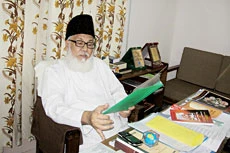
JAMAAT-E-ISLAMI leader in Bangladesh Motiur Rahaman Nizami has taken his party to new heights with his soft spoken and simple style. Not only has his party under his leadership managed to clinch power twice but Nizami — an MP and author of 25 books — has struggled for the lot of his constituency in the underdeveloped region of Santhia-Bera. He has been instrumental in the construction of highways, schools and colleges in this depressed area.
Nizami spoke to Arab News recently on various subjects ranging from the accusation that his party members are war criminals to the subject of interfaith dialogue in Bangladesh.
When asked how he feels about recent government persecution and vindication by the court, Nizami blamed the Awami League for carrying out a “political vendetta.”
“They steamroll their opponents,” he said. “They played this role from 1972 to 1974 and then again from 1996 to 2001. Even this time around they are playing the same role; in fact on a wider scale.”
He also accused the Awami League of “carrying out oppression” and stacking the courts in its favor.
“Whether judicial courts are actually free is doubtful by us,” he said.
When asked how he responds to war crimes accusation leveled against his party during partition, he said, “Even government secret agencies could not claim us to be war criminals.”
“Political vendetta is the only reason for bringing up the question of 38 years back a new,” he said. “To prove all the accusations they would have to take support of lies and produce fake witnesses. Our only crime in the eyes of secular forces is that we, the Jamaat, want to establish Shariah. We supported the BNP twice and that is a big reason for all this backlash.”
Commenting on Pakistan’s struggle with extremists, Nizami said, “Pakistan’s present situation is unfortunate, but it is a result of 9/11 and the occupation of Afghanistan. Muslim countries should be cautioned and learn lessons from the unfortunate Pakistani situation.”
Nizami said Islam is a “complete code of life” that is widely accepted by all walk of life in modern Bangladesh. “It is the result of Jamaat’s efforts,” he added. “Politically, Jamaat is far away from power. However in moral motivation and ideologies, Jamaat has created a base for an Islamic way of life in Bangladesh. This is the reason why Jamaat is disliked. The workers of Jamaat — each and every one — spend their own money. Every worker in Jamaat works according to the guidance given in the Qur’an and based on Allah’s commands. Jamaat workers contribute 5 percent minimum of their monthly income in the Jamaat fund every month. This is the main source of income for the Jamaat party.”
Nizami believes that in Bangladesh Islam has a bright future.
“Bangladesh has secured its position in the world as a progressive Muslim country,” he said. “Here the number of mosques and devotees offering obligatory prayers and religious madrasas are increasing rapidly. All this only goes to prove that in Bangladesh the foundation of Islam has strengthened. If democracy continues in Bangladesh then the future of Islam is very bright, inshaAllah.”
He continued: “Islamic parties cannot come to power overnight. If they run after power like other common parties then they will be able to clench power. However this rein of power will be short-lived. That is the reason why Jamaat-e-Islami has not moved in that direction. Muslims are in power, but not Islam. A certain international forum does not want Islamic parties to come to power. Most Muslims are all right in their faith, however we have to understand that for a long time the Muslims in the subcontinent were under British rule and it was at that time the Bangladeshi Islamic education pillars were damaged.”