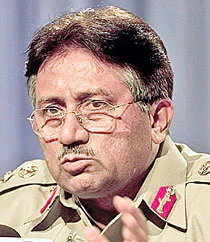
ISLAMABAD: Pakistan’s Supreme Court on Friday ruled former President Pervez Musharraf’s declaration of a state of emergency on Nov. 3, 2007 as unconstitutional.
Musharraf clamped a state of emergency and in his capacity as chief of army staff sacked Chief Justice Iftikhar Mohammed Chaudhry and 60 other judges of superior courts.
Lawyers raised anti-Musharraf slogans outside the courtroom as the verdict by the 14-member bench headed by Chaudhry was delivered.
The short order of the Supreme Court abolished the Islamabad High Court, which Musharraf had established. The judges who took oath under a provisional constitutional order (PCO) after the imposition of emergency will cease to be the judges of superior courts.
Friday’s judgment did not touch on whether Musharraf should be punished for his misrule, but lawyers and politicians said it was a landmark ruling that would deter future power grabs by Pakistani generals.
Hoping to secure a second term as president before giving up his dual role as army chief, Musharraf purged judges who stood in his way, suspended the country’s constitution and ordered the arrest of hundreds of political opponents in November 2007.
Farhatullah Babar, a spokesman for President Asif Ali Zardari, described the ruling as a “triumph of the democratic principles, a stinging negation of dictatorship.”
Neither Musharraf nor his lawyers attended this week’s hearings, despite being summoned by the court.
“It locks the door to future adventurism,” Aitzaz Ahsan, the leader of the lawyers’ movement that challenged Musharraf’s rule, told reporters.
A lawyer had asked the court to launch a treason case against Musharraf, but Chaudhry said the Supreme Court did not have the authority to do so. Under Pakistan’s constitution, any charges of treason against Musharraf would have to come from Parliament. The previous Parliament had endorsed Musharraf’s actions.
— With input from agencies