
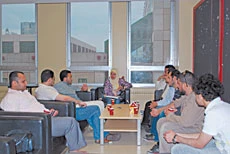
More than 25 years ago, Montreal’s top universities, multicultural atmosphere and bilingual system attracted many Saudi doctors and students to pursue their education and expand their horizons. Today, the Saudi Cultural Bureau in Canada states that there are more than 670 Saudi doctors in various disciplines of medical studies in 13 Canadian colleges. In addition, there are about 3,700 Saudi students on scholarships, either on the King Abdullah Scholarship Program or privately funded, in other non-medical areas.
“Montreal is an appealing destination to a lot of students, not just Saudis but also others from the Gulf region and the Middle East,” said Dr. Omar Al-Nozha, endocrinology fellow and faculty member at Taibah University in Madinah.
Al-Nozha said there is a big, long-time Arab community in Montreal. “The city welcomes people from different ethnicities and backgrounds and especially Arabs and Muslims. Students are less subjected to a culture shock,” he added.
Dr. Gassem Gohal, pediatrician and president of the Saudi Club in Montreal, said that in Montreal’s McGill University and L’Université de Montréal accommodate medical and non-medical students. “Concordia University is another option for students who wish to study other majors, but not medicine,” said Gohal.
According to the Association of Universities and Colleges of Canada (AUCC), Canadian universities attracted more than 70,000 international students in full-time study in 2005. Foreign student enrollment has more than doubled in the last nine years.
“McGill University is Canada’s Harvard,” said Al-Nozha. “A student with admission into McGill must never think twice. It’s one of the oldest and strongest universities in Canada.”
Dr. Yusuf Abdul Karim, a surgeon from the King Fahd Medical City in Riyadh, has been at L’Université de Montréal for the past two years. Its capacity allows it to accept triple the number of students at any other university in the country.
“But because of the French-speaking Quebecers and the great emphasis they place on the French language, it is inhospitable. It attracts only French-speaking students,” said Abdul Karim. Despite the university’s strict language rules, it is very supportive of students who show genuine effort to learn the language.
“I’ve been there for two years now and I see more Saudis joining. The university represents a long history for French Canadians. People might think of these regional and national aspects as obstacles,” said Abdul Karim. He added that French Canadians do not like outsiders trying to efface their French roots and heritage. “Students need to be aware of this before considering Montreal as a destination to study,” said Abdul Karim.
Mohammed Hamdan, faculty member at King Fahd University of Petroleum and Minerals in Dhahran and Ph.D. student of Electrical Engineering, said it is a very bad decision to send someone whose English fluency is below 20 percent to study in Montreal. “Because it’s a bilingual city. When you walk in a restaurant, shop or facility, people usually welcome you in French. It’s the language of communication here. Even if the person dealing with you spoke English, it won’t be perfect,” said Hamdan.
He said that students should either study French or at least be fluent in English before coming to Montreal. “To study English, there are other destinations. There are Toronto, Ontario, Hamilton, Victoria, etc,” he added.
Another issue that Saudi doctors addressed was the shortage of Canadian doctors that was publicly and heavily discussed in the media.
On Jan. 15, 2008, The National Post published an article entitled “Curing Canada’s doctor shortage” saying that Canada is undergoing a problem: The country needs an additional 15,000 doctors in order to keep up with demand, a figure roughly double the total number of students in all years of study at the 17 medical schools combined in Canada. “At a doctor-patient ratio of just 2.3 per 1,000 population, we are 24th on the list of 28 industrialized countries. Approximately 1.5 million Canadians cannot find a family physician as a result,” reported the article.
“That’s not the fault of Saudi doctors. There are universities that haven’t admitted students for the past two years,” said Dr. Abdullah Al-Suhaibani, radiation oncologist from King Faisal Specialist Hospital and Research Center in Riyadh. “Our existence here doesn’t create any competitiveness with Canadian doctors. It’s not like when we leave our positions, they are available for Canadian doctors.” To illustrate the situation, Gohal said in the pediatrics department of his hospital there are four vacancies to accommodate four Canadian doctors. “Four cannot of course occupy all positions or cover all hospital shifts,” he said. Therefore, there are four other vacancies for either Saudi or Arab doctors. “The media in Canada says why not substitute the Arabs with Canadians? The government says it could only afford four doctors. There is so much pressure and there were many parties involved,” said Gohal.
What really is a concern to Saudis in Canada and especially in Montreal is the lack of Saudi flights that fly directly from Montreal to Saudi Arabia.
“We have to fly via Europe to reach Saudi Arabia,” said Gohal. “The issue is pure profitability. I know that the number of Student in Canada can’t be compared to the huge number of students in America. But why not have direct flights from Saudi Arabia to Montreal?”
According to the website of the Canadian Transportation Agency, there is an Air Transport Agreement between the Government of Canada and the Government of the Kingdom of Saudi Arabia effective Nov. 14, 1990. The Bilateral Air Agreements and Designated Air Carriers table of contents shows that the Designated Canadian Airline is Air Canada where as the Designated Foreign Airline is blank under Saudi Arabia.
“Direct flights between Saudi Arabia and Montreal will not serve students only, but also Haj and Umrah pilgrims. There is a huge demand, especially that there are direct flights to Montreal from Jordan, Algeria, Egypt and Morocco,” added Gohal.
In spite of these minor hurdles, Canada and especially Montreal remains an attractive destination for students and doctors. The AUCC emphasis on its website that achieving diversity within the student population turns Canadian lecture halls into places for sharing a range of experiences, languages, customs and ideas — a benefit to all who increasingly learn and work in a global context.