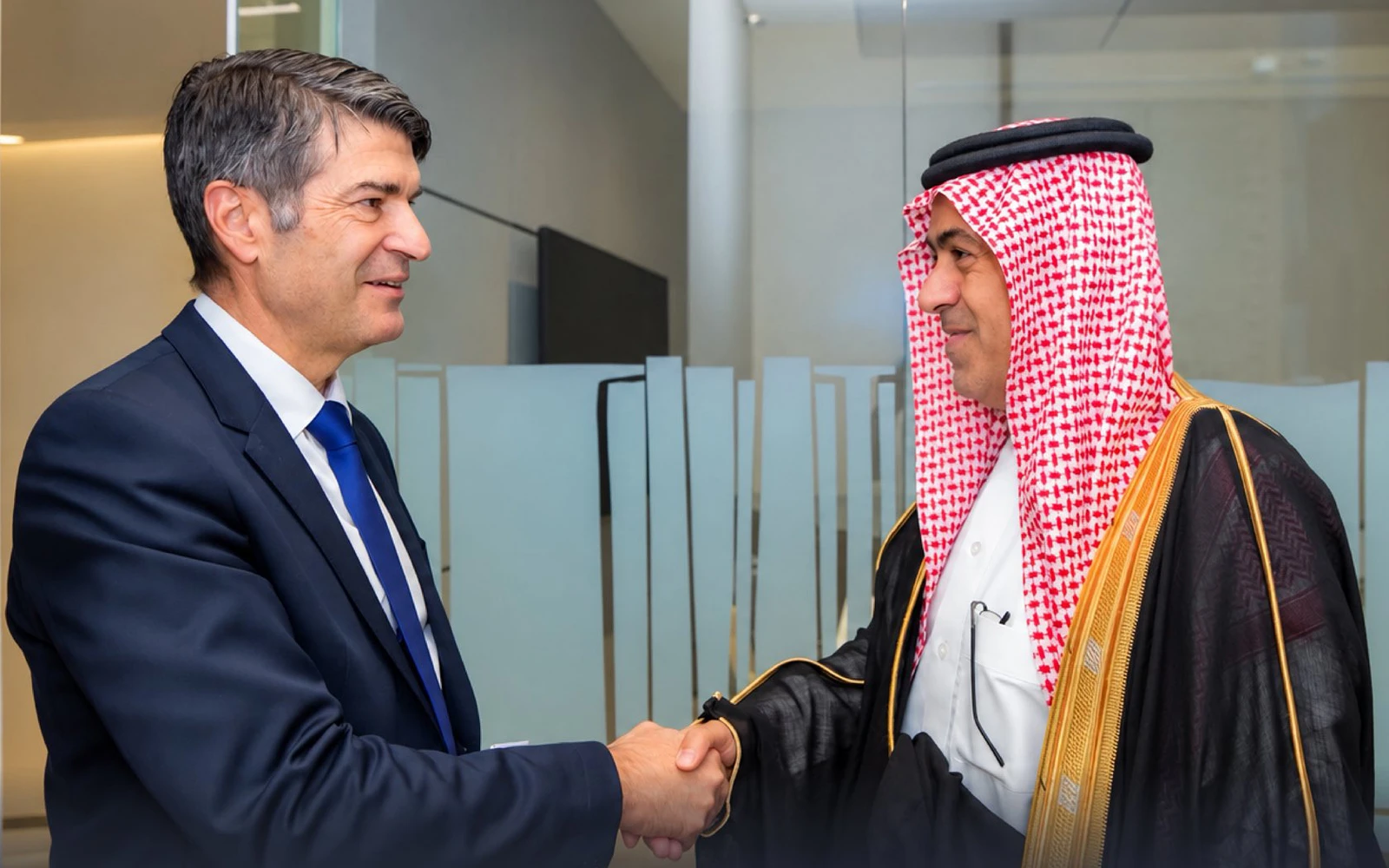
JEDDAH: Custodian of the Two Holy Mosques King Abdullah called on the Palestinians on Tuesday to set their house in order while exhorting them to unite not only to realize their dreams but also to combat the aggression of Israel.
King Abdullah expressed these sentiments in a message to Palestinian President Mahmoud Abbas, who opened the Fatah movement’s first congress in 20 years in Bethlehem on Tuesday.
“I frankly tell you that all that the arrogant and lawbreaking enemy could not do to the Palestinian cause over the past long years of continuous aggression the Palestinians themselves have done in a few months. I am telling you the truth, if the whole world jointly strove to establish an independent Palestinian state but the Palestinian house remained divided, nothing would be achieved.” The king quoted verses of the Holy Qur’an referring to the sanctity of Al-Aqsa Mosque and stressed the significance of the real spiritual unity between the people of the Grand Mosque in Makkah and Al-Aqsa Mosque.
“I entreat you in the name of Allah to rise above your pettiness and divisions to unite your ranks. If you do so then victory from God will be with you shortly.”
Opening the Fatah conference in Bethlehem, Abbas said Palestinians sought peace with Israel but “resistance” would remain an option. “Although peace is our choice, we reserve the right to resistance, legitimate under international law,” Abbas said.
Officials said a draft of Fatah’s program called for new forms of resistance, such as civil disobedience, against Jewish settlement expansion and a West Bank wall Israel says is for security but which Palestinians see as a land grab.
The draft leaves the option of “armed struggle” on the charter of Fatah if talks with Israel fail, and does not rule out a unilateral declaration of statehood in the West Bank and Gaza Strip if negotiations remain at a stalemate.
But Abbas stressed to the congress that Fatah had endorsed the 1993 Oslo Accords, which specifically recognize Israel, and was abiding by all of its obligations under the 2003 road map to peace and a two-state agreement with Israel.
Asked about Abbas’ reference to “resistance,” Mark Regev, a spokesman for Israeli Prime Minister Benjamin Netanyahu said: “Israel seeks historic reconciliation with our Palestinian neighbors — we want peace and the best way to achieve that is around the negotiating table.”
Israeli Defense Minister Ehud Barak, who has held a series of meetings with Obama’s Middle East envoy George Mitchell, said Israel should accept a plan Mitchell was expected to present to the parties “in the coming weeks.”
Tight security was in place as more than 2,000 delegates convened in a Christian school near the Church of the Nativity for the first Fatah congress since a gathering in Tunis in 1989.
More than 300 Fatah delegates living in the Gaza Strip were banned from going to Bethlehem by Gaza’s ruler, Hamas, whose fighters kicked Fatah out of the enclave in 2007.
Ismail Radwan, a senior Hamas leader, said Abbas’ speech was full of “fallacies and lies.”
He accused Abbas’ Palestinian Authority (PA) of complicity in Israel’s 22-day war on Gaza earlier this year. He said several European countries told Hamas that the PA “participated in the blockade on Gaza.”
Hamas spokesman Fawzi Barhoum also slammed Abbas’ speech as “hostile.” “This is a hostile speech and does not bode well for reconciliation (between Fatah and Hamas),” he said.
Barhoum was referring to Abbas’ statement at the convention blasting Hamas for preventing the Gaza-based Fatah members from joining the conference. Despite months of reconciliation efforts by Egyptian mediators, the two factions remain mutually hostile.
Abbas said neither Hamas nor any other Palestinian faction had the right to choose on its own what future “resistance” against Israeli occupation should entail. “No one can ... take us to where we do not want to be,” he said, echoing past criticism of Hamas attacks.
— With input from Hisham Abu Taha in Gaza City