NEW DELHI: Voicing his protest against the national hysteria raised by the media on swine flu, India’s Health Minister Ghulam Nabi Azad has said that India is better off in tackling swine flu than most advanced countries. After the World Health Organization (WHO) declared it a pandemic, signaling that swine flu is spreading fast, breaking geographical borders globally, the Indian Government stepped in effectively and contained the damage and prevented it from spreading rapidly. In a billion-plus population, around 1000 cases are being treated for swine flu.
Talking to Arab News, Azad spelt out the several measures initiated by him that eventually helped contain the damage of swine flu, ever since it was first reported in April. Azad said, “Among the measures we have launched include screening, contact-tracking, setting up separate isolated wards to treat cases of swine flue, increasing the number of testing centers and raising stocks of medicines to meet any eventuality, just in case it spirals out of control. We are prepared for any contingency.” Screening was not only physical but also in terms of collecting data by getting people to fill up forms.
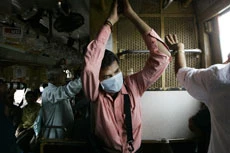
An important step has been the contact-tracking. It means that if a person arrived by an airlines, the ministry would contact the airlines to find out the names and addresses of the passengers seated close to him during the flight and track them down where they are and then put them under screening. “In a way, lack of precautionary measures could lead to the rapid spread of swine flu. Masks should not be disposed of in public places, as it causes spread of swine flue. There is a need for patients to isolate themselves from their own families.”
In the isolated wards in hospitals, separate team of doctors and nurses had to be earmarked, ensuring their own safety. It also meant delinking the ward from the central air-conditioning system, as it could be a circuit for spreading the swine flu and separate air-conditioning system had to be set up in these isolated wards.
Earlier, there were only two testing centers in Delhi and Pune. Seventeen more such testing centers have now been opened, taking the tally of testing centers to 19. Each swine flu sample testing costs Rs. 10,000 and the Health Ministry is bearing the burden.
Besides, stocks of medicines have been raised. At least 100,000 doses have been made available at the state level and about 10,000 doses at the district-level, so that there is no dearth of medicines.