
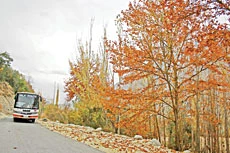
PAKISTAN’S north is the most spectacular and fascinating region. Here, the world's three famous mountain ranges meet — the Himalayas, the Karakorams and the Hindukush. The whole northern Pakistan is like a paradise for mountaineers, climbers, trekkers, hikers and anglers.
The Karakorams
The historic Karakoram Pass (5,575 m), an ancient trading route between the northern Pakistan and Xinjiang (China), gives its name to the range west of it that forms the watershed between the Indus and the Central Asian deserts. The eastern boundary of the Karakorams is the upper Shyok River from where it extends over 322 km westward to the Karumbar River and the Hindukush Range, to the north the Shaksgam tributary of the Yarkand River and to the south, the Indus bounds the Karakorams. Here, the Nanga Parbat (8,126 m) massif is the western anchor of the great Himalayan range which stretches in an arc 24,124 km east to Myanmar (Burma), a boundary and barrier, “the razor's edge” which for centuries has determined the destiny of South Asia. Such is the setting of the Karakoram Range, this remnant of a primeval Ice Age, “the third pole,” with extensive glacier systems and the greatest concentration of lofty mountains in the world.
Highest peaks
Of the 14 over 8,000 m peaks on earth, four occupy an amphitheatre at the head of Baltoro. Their shapes, forms, sizes and colors provide tremendous contrast, which defy description. These are; K-2 (8,611 m — world’s 2nd highest) — the undisputed monarch of the sky, Broad Peak (8,047 m) — massive and ugly; Gasherbrum-I (8,068 m) and Gasherbrum-II (8,035 m) — the “Pakistani Pyramids” that even Cheops would have preferred for a tomb; Muztagh Tower deceptively sheer; Chogolisa — the “Bride Peak”, in whose eternal embrace lies Hermann Buhl, the first man to climb Nanga Parbat; the Cathedrals of Baltoro with their great knife-edge ridges; the sky cleaving monoliths of Trango Towers and the most beautiful of all — the Peak of Perfection — Paiyu, (6,600 m) first climbed by a Pakistani expedition in 1977.
There are scores of over 7,000 m high peaks in the Karakoram Range and hundreds of nameless summits below 6,000m, mere points on the map. In the Lesser Karakorams there are equally great peaks such as Rakaposhi (7,788 m), the dominant giant in Hunza Valley. Its north face is fantastic precipice — 5,791 m of plunging snow and ice.
The Hindukush is also a mountain vastness containing hundreds of peaks, many above 7,000 m including Trichmir (7,705 m) that is the highest point of the range. The western bastion of the Himalayas is Nanga Parbat (8126 m), once dreaded as the “Killer Mountain”, but climbed many times by various expeditions since the first disasters.
Longest glaciers
Some of the longest glaciers outside polar region flow in the Karakorams. The Siachin Glacier is 75 km long. The Hispar, (52 km) joins the Biafo at the Hispar La (5,154 m) to form a 116 km long ice corridor. The Batura is 58 km in length. But the most outstanding of these rivers of ice is the Baltoro (62 km). This mighty glacier, fed by some 30 tributaries, constitutes a surface area of 1,219 km2. Seen from a distance, Baltoro appears smooth and beautiful but in fact it is a chaotic tumbling mass of rock and ice, troughs and hillocks and the debris of centuries. It is a unique, remote corner of earth. For here, in a frozen wilderness of crags, cornices and crevasses, rise towering spires of granite, great snowy peaks with fluted icy ridges and pinnacles that pierce the sky.
The Silk Route
For many centuries, caravans have braved these tortuous mountains treading precariously along paths providing shortcuts between the great towns of Central Asia and the rich markets of South Asia. However, the trails were hazardous, angry rivers horrifying to contemplate, and the nature's storms caused even the most intrepid to quail on the high passes and in the desolate gorges. In 1947, travel in and out of the northern Pakistan could have been described almost as it had been 15 centuries earlier by the Chinese pilgrim Fa Hien in 400 AD; “The way is difficult and rugged, running along a bank exceedingly precipitous. When often approaches the edge of it, his eyes become unsteady, and if wishes to go forward in the same direction, there is no place on which he can place his foot, and beneath are the waters of the river called the Indus.” Thus, the traders of yore had traveled over this route for centuries and carried silk, tea and porcelain from China to be bartered for gold, ivory, jewels and spices from South Asia.