
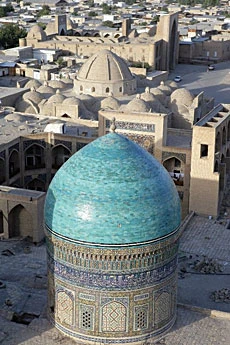
Tashkent will open its historic palaces to visitors from all over the world during the first two days of September. The openings are part of its 2200th anniversary celebrations.
Tashkent, a city that grew from a small settlement into one of the largest cities of Central Asia, is home to historic mosques, museums, deserts and caravan routes, snow capped mountains, greenery and rivers.
“We receive a million tourists per year but that's not enough and we want more,” Farrukh A. Vakhabov, director of Jahon Information Agency at the Ministry of Foreign Affairs, Uzbekistan told Arab News in an interview. The anniversary celebrations will spill over into the streets of the city. Concerts, parks and squares will feature programs of the best singers, dancers and musicians. Fireworks in honor of the city will conclude the festivities. The high point of the celebrations is the Palace of Forums. It is now under construction and is in the very center of the city. In other times, travelers and poets wrote about the amazing beauty of Tashkent, its buildings and gardens as well as the generosity and hospitality of its people. And today the capital of Uzbekistan has been playing a significant role in expanding intercultural dialogue and international cooperation. Tashkent is a city which contributed to the development of civilization and this was recognized by the world community which declared Tashkent the Capital of Islamic Culture in 2007.
Tashkent is at its architectural best in the old part of the city. At the Museum of Applied Arts one can see crafts from all over Uzbekistan. The Museum of Fine Arts has one of the best collections of art in all of Central Asia. The Uzbek Puppet Theater, the opera and ballet at the Navoi Theater both add color to the city. The Amir Temur Museum celebrates the life of Uzbekistan's most famous hero, Timur (Tamerlane) who was a courageous ruler and a great patron of the arts.
March through May and September through November is when Tashkent is at its best in terms of weather. Thrill seekers can get out of Tashkent and into the thick of the action rafting, trekking, cycling and skiing. The Syr Darya and the Angren rivers are placid and good for beginners while the fast flowing Chatkal, Ugan and Pskem, a few hours by road from Tashkent, can challenge even the experienced. The rafting season peaks in the months of September and October.
Chimghan, a three-hour bus ride from Tashkent, is a designated ‘recreation zone’, somewhat like a theme park in the great outdoors; it is a center for winter sports and has facilities for skiing.
Samarkand, located on one of the major trade routes to China and Europe, has prospered and attracted many people from the East and the West: Genghis Khan, Alexander the Great, Tamerlane, the Arab commander Kuteiba ibn Muslim and many others.
Historic Bukhara is one of the oldest trade and cultural centers of Central Asia. It is known for its heritage and architecture. When the Arabs arrived in Bukhara in the ninth and tenth centuries, they found it already prosperous trading center. During that period Bukhara became Central Asia's religious and cultural heart, brightened by the Persian love of arts.
Uzbekistan, whose growth of GDP in the first half of 2009 made up 8.2 percent, has implemented 667 production and infrastructural investment projects during the first half of this year. The country has been trying to attract investors from the Gulf to boost its tourism infrastructure and has signed several contracts with the United Arab Emirates on different projects. Recently, an Uzbek-Saudi business forum was held in Tashkent and was attended by business representatives from Uzbekistan and Saudi Arabia.
How to reach there
Dubai based Planet Travel & Tours is the General Sales Agent for Uzbekistan Airways and Uzbektourism (National Tourism Board of Uzbekistan), selling 'Destination Uzbekistan' throughout the Gulf. The group has packages to the major areas of Uzbekistan — Samarkhand, Bhukara, Khiva, the Ferghana Valley, Termez and Shakrisabz.