
JEDDAH: The Saudi Arabian Monetary Agency (SAMA) announced Monday that the country’s inflation rate was 4.2 percent in July, down from 11.1 percent for the same month last year.
“We expect the decline in the inflationary rate to continue through 2009, creating a better opportunity for financial development and stability,” SAMA Gov. Muhammad Al-Jasser said.
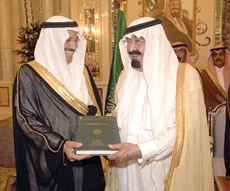
The central bank chief made this comment while presenting SAMA’s 45th annual report to Custodian of the Two Holy Mosques King Abdullah during a ceremony at Al-Salam Palace.
“The national economy continued its strong growth in 2008 for the sixth consecutive year as the gross domestic product (GDP) grew by 4.5 percent while the private sector grew by 4.7 percent,” he said.
Speaking about the Kingdom’s economic performance in 2008, Al-Jasser said the budget surplus reached 33 percent of GDP while the balance of payment surplus stood at 28.6 percent.
The Kingdom’s banking sector continued its constructive role of financing economic activities as monetary supply rose by 17.7 percent in 2008 while credit facility granted to the private sector increased by 27.1 percent.
Al-Jasser also referred to the qualitative development achieved by the Kingdom following the formation of the Supreme Economic Council (SEC), a mini-Cabinet chaired by King Abdullah. The SEC took 70 major decisions on economic and structural reforms and 165 decisions on organizational and administrative development over the past years.
“As a result of these decisions the Kingdom achieved remarkable economic performance in recent years with the private sector GDP maintaining an average annual growth rate of 5.5 percent in the past five years,” he said. During the same period, the Kingdom’s nonoil exports rose by 23.2 percent annually.
Saudi Arabia’s investment environment has improved considerably over the past years and the Kingdom is now ranked 16th out of 181 countries in terms of competitive environment, business performance and investment, according to the Best Business Practice Report issued by International Finance Corporation (IFC), an affiliate of the World Bank, in 2009.
He emphasized the need to diversify income sources and reduce dependence on oil as a source of income through giving the private sector a greater role in the national economy. He praised the king for allocating the Kingdom’s budget surplus for educational and training projects and for carrying out infrastructure projects such as roads and water networks.
Referring to the global economic crisis, the SAMA chief said it had limited effect on the Saudi economy. “Saudi banks were not affected noticeably thanks to the policies adopted by SAMA in monitoring financial institutions,” he explained. Al-Jasser commended King Abdullah’s directive in adopting a strong and effective financial, monetary and banking policy, adding that it had helped Saudi Arabia in overcoming the financial crisis.
“Many countries have admired the Kingdom on this success story,” he added.
Al-Jasser said SAMA had taken a series of measures to ensure adequate liquidity in order to meet local requirements and reduce the cost of lending. “This policy enabled Saudi banks to continue their role in financing development projects,” he said, adding that King Abdullah had instructed SAMA to focus on long- and medium-term policies to achieve financial stability rather than opting for short-term economic decisions.

