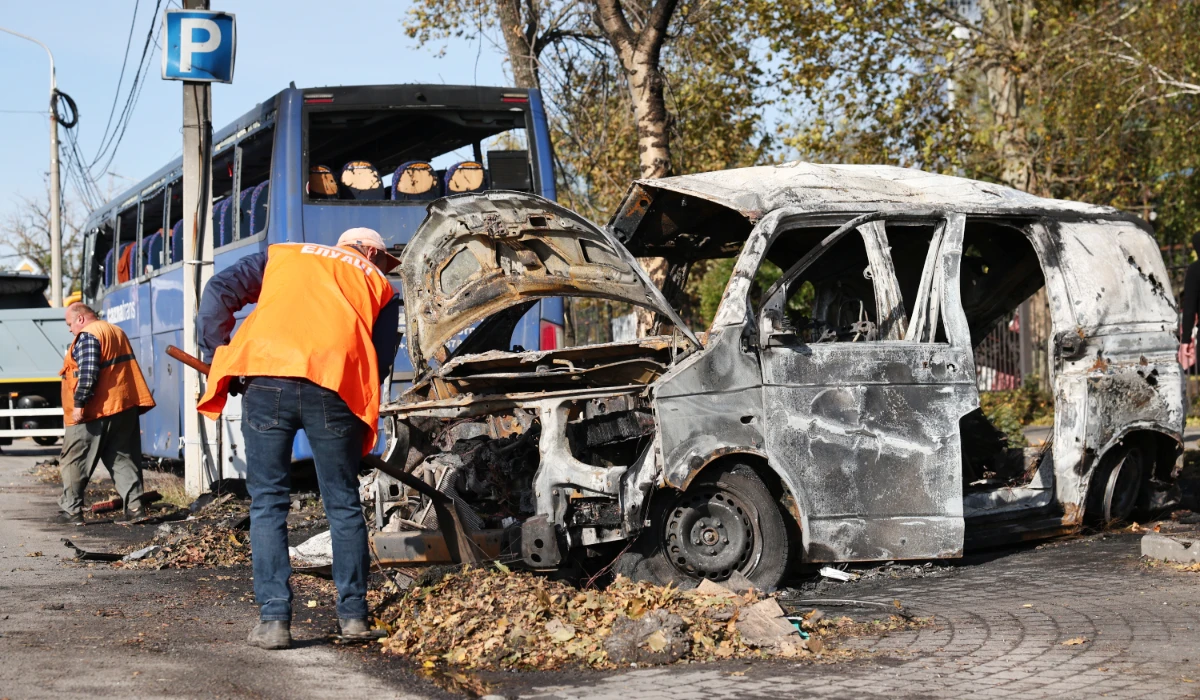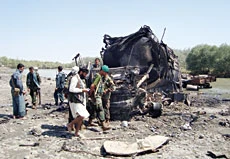
KUNDUZ, Afghanistan: A NATO aircraft blasted two fuel tankers hijacked by the Taleban in northern Afghanistan, setting off a huge fireball early on Friday that killed up to 90 people, including 40 civilians who had rushed to the scene to collect fuel, Afghan officials said.
The airstrike is likely to intensify concern over civilian casualties in the Afghan war. Top NATO commander, Gen. Stanley McChrystal, has ordered curbs on airstrikes after a strong backlash among Afghans over civilians killed in military operations.
In Kabul, the NATO command said a “large number of insurgents” were killed or injured in the pre-dawn attack near the village of Omar Khel in Kunduz province.
In Brussels, the alliance’s chief said it was possible civilians died. Kunduz Gov. Mohammad Omar said 90 people were killed. A senior Afghan police officer, speaking on condition of anonymity because of the sensitivity of the information, said that included about 40 civilians who were siphoning fuel from the trucks. Gov. Omar later lowered the figure to 72. But Afghan President Hamid Karzai’s office said 90 people were killed and wounded. Karzai announced he was creating a panel to investigate the attack. “Targeting civilians is unacceptable for us,” he said.
Navy Lt. Cmdr. Christine Sidenstricker, a public affairs officer, said the attack occurred after commanders in the area determined that there were no civilians there.
In Brussels, however, NATO Secretary-General Anders Fogh Rasmussen said earlier “a number” of Taleban fighters were killed and “there is a possibility of civilian casualties as well.” The German military, which has troops under NATO command in Kunduz, said the airstrike struck the tankers at 2:30 a.m., killing 50 insurgents, adding that “uninvolved (persons) were presumably not harmed.”
Militants seized the tankers about 7 km southwest of a German base and an unmanned surveillance aircraft was dispatched to the scene, German officials said. After the images showed no sign of civilians, the Germans called for a US airstrike, which occurred about 40 minutes after the tankers were seized.
Taleban spokesman Zabihullah Mujahid said the trucks were headed from Tajikistan to supply NATO forces in Kabul.
Mujahid said that when the hijackers tried to drive the trucks across the Kunduz River, the vehicles got stuck in the mud and the insurgents opened valves to release fuel and lighten the loads. He said villagers swarmed the trucks to collect the fuel despite warnings that they might be hit with an airstrike.
Mujahid said no Taleban died in the attack.
Abdul Moman Omar Khel, member of the Kunduz provincial council and a native of the village where the airstrike happened, said about 500 people from surrounding villages swarmed the trucks before the attack.
He said villagers told him insurgents had invited them to help themselves to the fuel.
“The Taleban called to the villagers ‘Come take free fuel,”’ he said, and the prospect of free fuel must have been irresistible. “The people are so hungry and poor.” He said five people were killed from a single family, and a man he knows named Haji Gul Bhuddin lost three sons.