
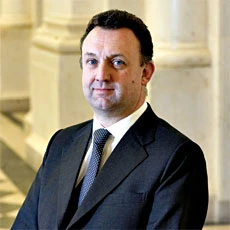
Kuwaiti Islamic finance group The Securities House has restructured its presence in the UK with the recent merger of its two wholly-owned subsidiaries, Global Securities House (GSH) UK and its flagship Gatehouse Bank plc, the latest of the Islamic investment banks authorized by the Financial Services Authority (FSA) in London. Given the current market conditions and the potential overlapping of business, this was a merger waiting to happen. Leading the restructuring and consolidation effort at Gatehouse Bank is Richard Thomas, a doyen of Islamic banking in the UK, having worked in the sector for over 25 years, first starting with Saudi International Bank in the early 1980s, then with United Bank of Kuwait and with ABC International Bank in London. In this interview with Arab News Richard Thomas, CEO of Gatehouse Bank plc, discusses the rationale behind the merger between GSH (UK) and Gatehouse Bank, the objectives and the focus of the bank over the next few years. Excerpts of the interview:
Can you explain the merger between GSH (UK) and Gatehouse Bank plc?
GSH UK was formed first with a dual mandate —- one to commission the bank and the other to run the family office for the group, focusing primarily on real estate and asset management. The original business plan for Gatehouse Bank focused a great deal on Islamic capital markets, particularly the debt market. It was envisaged that both would operate separately providing different solutions. The bank got its FSA authorization in May 2008. We then applied for an authorization for GSH (UK) to provide Islamic investment advisory services outside of the family office for the Group, and we got that license. We started to provide investment advisory and asset management services to third parties. As the year progressed it became clear the two authorized entities were doing the same thing. The bank with the slowdown of the Islamic capital markets and the increased emphasis on institutional wealth and asset management, it became clear that a lot of what GSH was doing, Gatehouse was also involved with, but for different clients. In the end we had two institutions doing much the same, but with two separate sets of authorization. So we merged the two entities bringing the investment advisory and asset management expertise of GSH alongside the capital markets experience of Gatehouse Bank to strengthen the organization and to reduce the administrative costs.
Was there any need to get the authorization status of the new Gatehouse Bank expanded?
No, technically under the original Gatehouse Bank authorization it could participate in investment advisory, asset management and Islamic capital markets activities.
What are the core objectives of your restructuring for the new Gatehouse Bank in terms of business?
It is more or less the same but with a much greater emphasis on the management of bespoke assets for the market. We are still concentrating on the development of capital market products; on putting together funds that would be attractive to the institutional market like our Water Fund and the London Property Fund; on doing direct investments and bilateral business. There has been no material change. Obviously David Testa, the first CEO of Gatehouse Bank, left us because there cannot be two CEOs. Apart from that we have had no material change of staff. If certain business lines grow, we may in fact recruit more staff in the future.
Can you clarify your business objectives? Are they focused on the UK market or bridging the Middle East with the UK and Europe or wider?
We have a three-pronged focus. We have the role of intermediating capital coming out of the Middle East looking for opportunities in the West, which may be investment or direct equity. We have a second mandate to develop facilities for UK and European corporates and to bring the Islamic finance mandate to them. We have just started on this, which is really a 2010 focus. The third focus is to internationalize the business across non-core markets into non-traditional jurisdictions, particularly Asia with a concentration on Malaysia.
Will you use the bank as a base to expand to the US market?
The Securities House Group and GSH already have business in the UK and Gatehouse Bank will further benefit from these connections. But any such business will be done through Kuwait and will only be in investments. We do not have plans to develop a presence in the US market.
Can you expand on your plans for Europe and Malaysia? What sort of opportunities are you looking for?
We are keeping a close eye on the developments in France, although the French have still got a long way to go in achieving their objectives, no matter what their PR might say. We have an ambitious French project under way, which is ongoing and looking at France as a jurisdiction for Islamic finance to internationalize the reach of Islamic finance as a mode of finance. This project also tracks and helps with the development of Islamic finance in France, and we would extend that to any mature economy in Europe that is interested to learn from the experience in London. It depends on the ability of the market to open up there. We would keep a commercial interest there as well in the medium term. We have an interest in the infrastructural development of France as a center for Islamic finance in Europe. We also have an interest in France as a destination for investment capital. We are interested in investing in French property.
Are you disappointed that the French rhetoric does not match the reality?
I am not surprised. I have learned that small steps over many years reach targets. In the UK we have had a lot of rhetoric but over time we have achieved and delivered a lot. I am sure it will be the same for France. They have to make political statements. They do seem to be doing some work and if they so desire we would be there to help them.
Do you find Malaysia an exciting prospect for Gatehouse Bank?
Yes I do. The opening up of the Islamic finance market through the liberalization measures announced in April this year and over the years; Malaysia’s interest in developing cross-border activity has been a revelation. I have been looking at Malaysia for 20 years and found it a difficult market to penetrate in the past. But suddenly with the new regime and the liberalization, the work done by Governor Dr. Zeti Akhtar Aziz at Bank Negara Malaysia and Chairman Zarinah Anwar at the Securities Commission of Malaysia has really made the difference. We are directly engaged with the work done by Bank Negara in the Islamic banking sector and by the Securities Commission in the capital markets. We have some small direct equity investment in Malaysia but we are also working very closely with the authorities there and with Bursa Malaysia, the stock exchange, in developing future products. From the banking side we are seeing progress on standardizing capital markets and money market products that would allow London and Kuala Lumpur to cooperate much more in the future in purely banking finance. In terms of asset management there are a lot of opportunities for Malaysia not only as a destination for capital, but also as a source of capital for regional investment.