
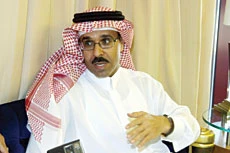
When Nadhmi Al-Nasr joined Saudi Aramco in 1978 with a degree in chemical engineering it is unlikely he could have imagined that 31 years later he would be leading one of the most ambitious projects to build a world-class graduate university ever attempted, but that is exactly what he is doing now. Al-Nasr has been serving as the interim executive vice president for the King Abdullah University of Science and Technology (KAUST) since December of last year and been working on the project since its inception. Initially Custodian of the Two Holy Mosques King Abdullah requested Ali Al-Naimi, the Kingdom's minister of petroleum and minerals, to take the lead on this project. Al-Naimi, who also serves as chairman of the board for Saudi Aramco, decided that the company's project engineering and management expertise would be used to ensure excellent results. Additionally, the company's leadership in upstream and downstream hydrocarbon research and development also would be a plus. That is when Al-Nasr, the company's executive director of Engineering Services, got involved.
“KAUST is going to be a graduate school focusing on research and technology,” Al-Nasr told Arab News. “It is the vision of Custodian of the Two Holy Mosques King Abdullah to have this university to be a turning point for higher education. Hopefully it will act as a catalyst in transforming Saudi Arabia into a knowledge economy by directly integrating the research outcome of the university into our economy. That really is the vision of King Abdullah.”
He said that although the university likely will have an impact on the Kingdom's higher education system, the primary function will be research.
“The university is not driven by education; it is going to focus purely on research. We are confident that since this university will work in close conjunction with other universities in Saudi Arabia — especially the leading universities such as King Fahd University of Petroleum and Minerals (KFUPM) in Dhahran, King Abdul Aziz University in Jeddah and King Saud University in Riyadh — it will raise the level of research and technology.”
Al-Nasr said that while scholarships for the university will be available, the recipients will be the best and the brightest.
“The requirement for entering this university is extremely high, which means students will have to compete on a higher base to enter,” he said.
“Of course, we are working hard to make sure that a big portion of those students will be from Saudi universities and many Saudi studying all over the world. We are targeting universities in Europe, in the United States, and Asia. Even in the US and Europe we are targeting Saudi students. KAUST is an international university, which is not going to be limited to Saudis. We will, however, try as hard as we can to get as many talented Saudis as we can from within Saudi Arabia and abroad.”
By nature of the university envisioned as second to none, the bar likely will move higher for other colleges and universities in the Kingdom.
“We think these steps will help other universities to transform and improve for the better. That is a positive impact we envisage as a result of the creation of this new university. That is one part. The other part hopefully as we succeed at KAUST to put together the right model for research work, other leading universities will follow this model, which is basically the model of linking the research institute with the business and economy.”
Al-Nasr said the location of the university on the Red Sea coast near Thuwal demonstrates the Kingdom's growing interest in offshore resources and environmental protection as well as the country's rapidly expanding petrochemical industry. “We will be doing research on the Red Sea itself — on the fishery and the marine life,” Al-Nasr said. “Secondly, it really is an extension of the future area that is going to run from Rabigh all the way to Thuwal. It is going to be the petrochemical complex (Petro Rabigh), King Abdullah Economic City and KAUST. So that line between those two areas hopefully will be the future of Saudi Arabia. It is going to be a hub of industry, commerce, education, business and research.”
Al-Nasr said the most exciting aspect of his involvement has been a chance to meet King Abdullah and share his passion and enthusiasm to propel the Kingdom forward. “King Abdullah has had this idea for decades, and he speaks about this having been his dream for a long time. He is extremely happy and proud that his dream has finally taken shape. His vision is to see KAUST as a driver for transformation of the Saudi economy into a knowledge economy. It may be easy for us to say we want to transform the economy, but it is a long journey for a nation to undertake. He believes that KAUST is the starting point of that transformation,” Al-Nasr said.
“It will lead to a chain reaction. It is transforming a nation into a knowledge economy through this research-based university that relies on the best talents of the world to be together in one place. If you can manage to bring the best talent and provide them the best environment for excelling in science and technology and then link that mind power to your economy, making sure the discoveries and inventions are capitalized upon and implemented by business, you can start to make that transformation. In addition to that we hope, and so does King Abdullah, that it will bring back to us as a nation — Arabs and Muslims — the great history of the Golden Age of Islam when we were leading the world in science and technology. We believe we can do that, and KAUST hopefully is a step in that direction. There is no reason why we shouldn't be up to it.”
Earlier in his career, Al-Nasr played a leading role in Saudi Aramco's Shaybah Development Program, in which the company conquered the trackless sands of the Rub Al-Khali desert developing the energy resources of the Kingdom's Empty Quarter and building facilities, highways and pipelines in seemingly impossible conditions. Al-Nasr says Shaybah pales in comparison to the scope of the KAUST project. “KAUST goes beyond an execution challenge — it will hopefully transform the nation economically. It is like bringing the world to Saudi Arabia and projecting the best image of Saudi Arabia to the world.” Al-Nasr said the KAUST project is more than blueprints, bricks and mortar. “To do all of this in a short period is a true challenge,” he said.
“It is not just the execution of a building; it is really getting the world academics and international research institutes to back you — without that support KAUST wouldn't make it. It is not something that you can do on your own, so the challenge was how to bring that whole world with us and convince them that it is a sincere project that is the vision of a great leader and that we as a nation are up to it. The challenge also was how to bring that change within the Kingdom. How to get our universities in the Kingdom to see it as complementary and positive healthy competition? How to maximize the participation of students in Saudi Arabia? When I compare KAUST with Shaybah it is a completely multidimensional challenge.” Al-Nasr says having Saudi Aramco become so involved in the project makes perfect sense.