
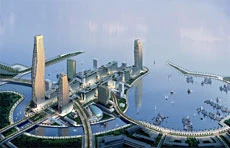
Saudi Arabia's plan for establishing new major economic cities signifies the bold steps it has taken toward diversification of its economy.
The first boom in the 1970s saw the building of the industrial cities of Jubail and Yanbu while the current boom has brought to the fore new economic cities. The Kingdom's oil revenues continue to remain high, but the economic cities offer opportunities to investors by capitalizing on the Kingdom's comparative advantage: low-cost energy.
The economic cities also reflect a new vision for the Kingdom. Time will tell how these cities will look and how society and business will respond to them. The logic for building the cities is founded on the principle of creating economic opportunities in areas outside the main urban areas of Saudi Arabia.
According to a recent study prepared by the Center for Studies and Research, the Kingdom's economic cities, still in the pipeline, will contribute $150 billion to the country's gross domestic product (GDP) in addition to creating 1.3 million new jobs by 2020 and increase the per capita GDP to SR125,625 for those living in the cities.
While the government will play the role of a regulator, facilitator and promoter of these cities, the private sector will find the required capital, real estate and developers of projects in the cities, the study said.
“The economic cities need to still prove themselves as viable and autonomous entities that can create ample business and employment opportunities mainly for Saudis. One of the guiding concepts behind the cities is that of decentralization, which the Kingdom is in need of. Spreading growth is an important principle and regional development is an important component that could drive the economic cities. But there are those who would argue that focus has to be on urban areas that continue to face various challenges,” John Sfakianakis, chief economist at the Riyadh-based Banque Saudi Fransi, said.
The Samba Financial Group said the economic cities are based on public-private partnership models, under which the public sector provides some basic services and a range of incentives, with private sector firms delivering the rest.
The cities are based on the ideas of vertical integration and “clustering.” This is most clearly seen at the King Abdullah Economic City (KAEC), where the Kingdom's petroleum resources will be harnessed to provide low-cost feedstock for the petrochemicals sector. From these basic chemicals will be derived a range of intermediate goods and plastics, with firms clustering in the planned “plastics valley” area of the city's industrial zone. These plastics and associated products can then be shipped in a relatively easy manner from KAEC's deep-water port, either north to Europe through the Suez Canal or down the Red Sea to Asia. To service this core industry there will be a range of complementary sectors, such as logistics, information technology, and financial services.
“Unsurprisingly the recent global financial turmoil has caused some slowing of private sector investment in the cities. Although $35 billion in finance was raised for KAEC in 2008, credit conditions for many local and international firms have become far more difficult since the middle of last year and fresh investment is proving more difficult to attract,” Howard Handy, chief economist at Samba, said.
Emaar the Economic City, which is spearheading the development of KAEC, has acknowledged that the completion of the city might be delayed beyond the 2025 deadline, and that potential investors are demanding better terms, but it says that interest is still high, particularly now that construction costs have eased. Moreover, the company says it is largely unconcerned by the short-term vicissitudes of the economic cycle, pointing out that constructing a city takes many years and will encompass a number of such cycles.
There has also been a notable slowdown in the pace of activity at Knowledge Economic City in Madinah, while development of the master plan for Prince Abdulaziz bin Mosaed Economic City in Hail (northwest of Riyadh) has been subject to a series of delays.
Better progress has been made at Jazan Economic City in the southwest of the country, where construction began in January on a $360 million steel plant, the funds for which were partly raised from the public sector.
The body overseeing the cities, Saudi Arabian General Investment Authority (SAGIA), says that its plans are flexible enough to cope with short-term dislocations in credit markets. In practice this might mean that the scope and timing of various elements of the cities will be revisited, while additional public funds might also be made available, although at the moment SAGIA is not in a legal position to provide financial guarantees.
SAGIA's confidence is partly supported by the impact of lower construction costs and the government's overall commitment to the projects, which is still strong. The authorities view the economic cities as an important means of generating jobs in more remote areas of the country where unemployment rates are particularly high. Thus, the long-term viability of the cities is underpinned by significant political will.
“Sustainable finance is a major challenge for the economic cities as credit is not easily available, either in Saudi Arabia and abroad. The country needs to witness a new wave of change and the economic cities might offer that but there is always a gap between the planning and execution of any such massive project,” Sfakianakis said.
The King Abdullah Economic City is located in Rabigh, midway between Makkah and Madinah, north of the commercial hub of Jeddah. It encompasses some 168 square kilometers. The Knowledge Economic City, situated in Madinah, seeks to develop the Kingdom’s technology base.