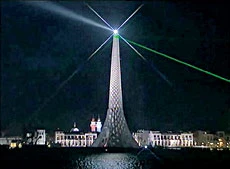
BRISBANE: Leading international design studio Urban Art Projects (UAP) had completed the 60-meter-high Breakwater Beacon, the centerpiece of King Abdullah University of Science and Technology (KAUST), according to a press release.
The Breakwater Beacon was unveiled during the inauguration of KAUST as part of the two-day celebration. Custodian of the Two Holy Mosques King Abdullah hosted more than 3,000 guests, including prominent Saudis, foreign leaders and Nobel laureates during the glittering inauguration ceremony.
Daniel Tobin, principal of Australia-based UAP, which creates site-specific art and design commissions for architectural and landscape environments, including the arts program for the Shanghai World Expo 2010, designed the beacon. The striking structure creates a contemporary interpretation of a lighthouse and will act as a symbol for the university.
Led by Tobin, UAP’s design draws inspiration from ancient Arabic maritime traditions, in-region artwork and architectural detailing, linking to the marine ecology of the Red Sea.
Built in pre-cast concrete blocks, Breakwater Beacon’s complex structure is a collection of unique amorphous hexagonal sections stepping up out of the Red Sea into an elliptical spire. The reverential interior space — with the patterned skin of the atrium creating a dappled shaded effect — is designed for communal gatherings and includes an amphitheater and reflection pond. Breakwater Beacon is part of a major international arts program at KAUST to celebrate its international platform of collaboration and exchange. Curated by UAP, the primary focus of the program is to interpret and present interdisciplinary art and design that stimulates creativity and interaction, drawing inspiration from KAUST’s unique geography, science and technology-based research, language, text, regional histories and traditions.
The program includes work by the renowned Tunisian artist Nja Mahdaoui and Swedish artist Carsten Holler, who is known for his Unilever installation at the Tate Modern.